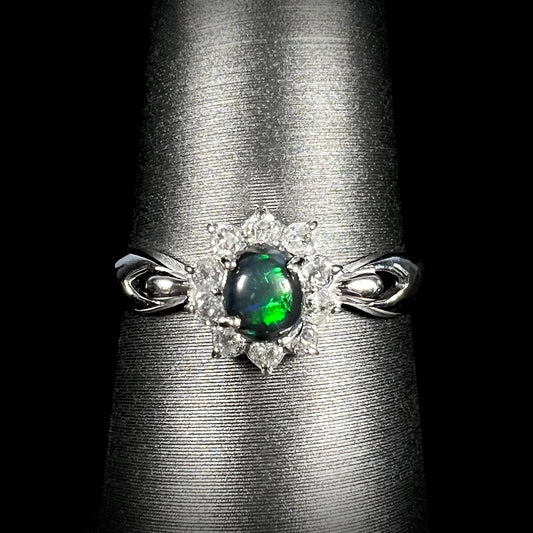
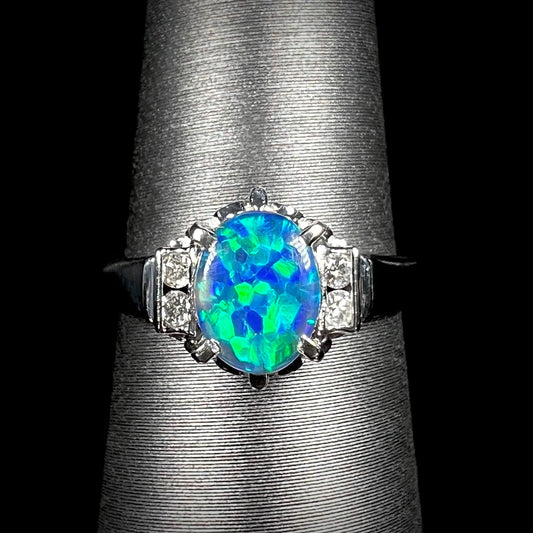
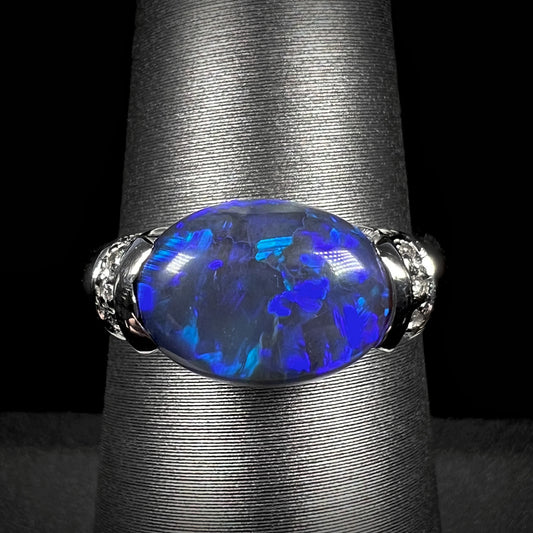
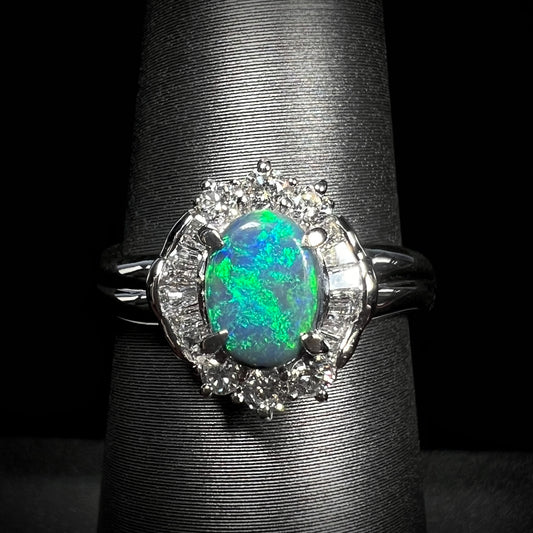
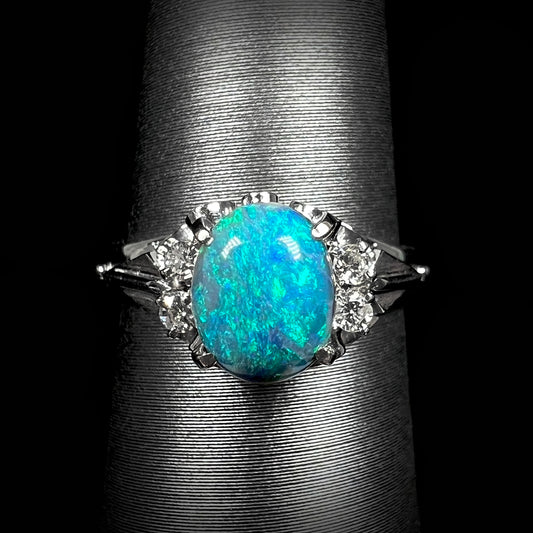
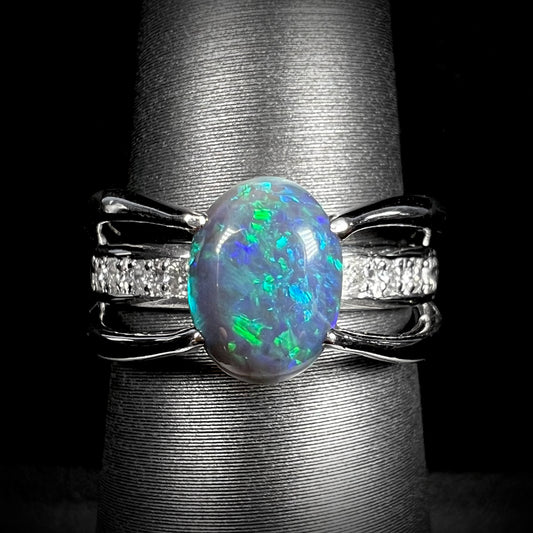
Black opal is among the most frequently misunderstood varieties represented in our broader opal jewelry collections. It does not refer to black play-of-color, nor does every black opal appear jet-black. Even respected gemological institutions differ in how the variety is classified, making an understanding of body tone particularly important.
Below, we explore what makes an opal “black,” how its body tone is judged, where and how it forms, why exceptional examples command substantial prices, and how to distinguish natural black opal from synthetic, treated, and assembled alternatives.
What Is Black Opal?
Black opal is distinguished by its black or nearly black body tone. When play-of-color is present, this dark background creates a striking contrast that can make even small flashes of color appear exceptionally vivid.
Not every dark-looking opal qualifies as black opal, however. Definitions have evolved over time, and terminology remains somewhat inconsistent between mining regions, gemological institutions, and international jewelry markets.
At OpalPop, we follow the body-tone classifications established by the Australian Opal Association, which recognizes black opal as having a body tone of N1 through N4 on a nine-grade scale.
Black Opal Body Tone: Understanding the N1–N9 Scale
The Australian opal industry uses a body-tone scale adapted from the Munsell system, ranging from N1—the darkest—to N9, the lightest.
Under this classification, body tones are divided into three principal groups:
- N1–N4: Black opal
- N5–N6: Dark opal
- N7–N9: Light opal, with N9 specifically classified as white opal
Historically, some dealers and gemological institutions used the term semi-black to describe material now more commonly classified as dark opal. Terminology has not always been consistent between Australian miners and international dealers, and some older grading systems used a five-point rather than nine-point scale.
The distinction between black and dark opal is not universally observed—even among the world's leading gemological institutions. Organizations such as GIA use broader definitions that include opals with dark backgrounds, while sellers in both domestic and international markets may similarly classify dark opals as black opals. At OpalPop, we adhere to the stricter Australian Opal Association standard, reserving the designation black opal exclusively for stones with N1–N4 body tones.
Body Tone vs. Body Color: Why Black Opal Is Not Always Jet-Black
An opal's body tone and body color are related, but they are not interchangeable.
Body tone describes how dark or light the stone appears when its play-of-color is disregarded. Body color describes the underlying hue, which may be black, gray, blue, brown, or another color.
Consequently, a natural black opal can appear distinctly blue while still qualifying as N3 or N4. Only the darkest examples, particularly N1 and some N2 stones, approach the jet-black appearance that many unfamiliar buyers associate with black opal.
Equally important, body tone is assessed from the face of the opal—not its reverse or sides.
The back of a natural black opal may be gray, brownish, or even pale, while its edges can sometimes appear translucent or nearly transparent. These characteristics do not automatically disqualify a stone from being black opal.
To judge body tone accurately, examine the stone face-up while mentally disregarding its play-of-color—as though every flash of red, green, blue, or violet had been extinguished.
Body tone can also vary across a single stone. Natural inclusions, potch, and differences in the thickness of the precious opal may create areas of varying darkness. In such cases, the overall face-up appearance determines the most appropriate classification.
Is an N1 Black Opal More Valuable Than an N4?
Not necessarily.
There has long been disagreement within the opal trade about whether darker body-tone grades deserve a premium when all other characteristics are comparable. Some industry perspectives treat black opal as a single valuable category, while others place particular emphasis on the near-jet-black appearance of N1 and N2 stones.
In practice, brightness, color profile, pattern, coverage, directional play-of-color, and overall visual attractiveness can outweigh relatively small differences in body tone.
An exceptionally bright N4 displaying strong red, orange, and green will be considerably more valuable than a dull N1 displaying only weak blue.
The more consequential dividing line is often between N4 black opal and N5 dark opal. These neighboring grades can look remarkably similar, yet the Australian classification draws a firm distinction between them—a distinction that can meaningfully affect market pricing.
For buyers more concerned with appearance than formal classification, high-quality dark opal can therefore represent an attractive alternative to black opal.
Body-tone assessment remains partly subjective, however. When a stone sits near the N4–N5 boundary, sellers have an obvious commercial incentive to interpret it as black opal. At OpalPop, we aim to apply the Australian standard conservatively rather than assign the darker grade simply because it would justify a higher asking price.
Why Is Black Opal Black? Natural Potch and Formation
The dark appearance of most Australian black opal is associated with naturally occurring black potch—common opal that lacks the ordered internal structure responsible for precious play-of-color.
Black potch may form beneath the precious opal, intermingle with it, or extend through portions of the stone as fine inclusions. These inclusions can create dark, web-like patterns that become particularly striking under magnification.
Importantly, such webbing is not necessarily evidence of cracking. Natural black potch can form irregular lines and segmented structures that closely resemble fissures, despite being an inherent part of the stone's formation.
Many black opals are cut with a layer of potch remaining on their reverse. This can provide support for a comparatively thin precious opal layer, but it also contributes to the stone's total weight.
This is one reason carat weight should never be treated as the defining measure of an opal's value. A relatively heavy black opal may contain a substantial amount of non-precious potch, while a lighter example may display a far more exceptional face of precious color.
Naturally Layered Black Opal: The So-Called “Natural Doublet”
A particularly interesting form of black opal occurs when a layer of transparent or translucent crystal opal develops naturally over black potch.
Viewed from the side, the precious opal may appear nearly clear. From above, however, the black potch beneath it provides a dark background that intensifies the play-of-color, creating the appearance of a conventional black opal.
In Opal Identification and Value, Dr. Paul Downing explains that such stones were historically described by some members of the trade as natural doublets.
The Australian Opal and Gem Industry Association, a predecessor of today's Australian Opal Association, rejected this terminology because it risked confusing naturally formed black opal with artificially assembled opal doublets.
The distinction is fundamental: these naturally layered stones have not been glued, assembled, or artificially enhanced. Their structure developed in the earth, and they are evaluated according to their natural face-up appearance.
OpalPop has handled examples of this formation in which the crystal layer appears remarkably transparent when viewed from the side, yet produces vivid, unmistakable black-opal coloration from the front.
Are There Different Types of Black Opal?
Although conventional solid Australian black opal is the form most widely associated with the term, several natural opal varieties can display qualifying black body tones.
Solid Black Opal
Traditional solid black opal is most strongly associated with Lightning Ridge, Australia. The term solid distinguishes naturally formed opal from artificially assembled products, such as doublets and triplets. It does not, however, indicate whether the material exhibits precious play-of-color.
Gem Black Opal
Gem black opal is natural, solid opal with a qualifying black body tone (N1–N4) that exhibits precious play-of-color. Its dark appearance generally results from naturally occurring black potch within or beneath the precious opal. Fine examples display brilliant play-of-color against a dark background and represent some of the most sought-after gemstones in the opal trade.
Common (Potch) Black Opal
Common black opal, also known as black potch, is naturally occurring opal with a qualifying black body tone (N1–N4), but without precious play-of-color. Although generally not valued as a gemstone in its own right, black potch plays an integral role in the formation and appearance of many fine gem black opals, providing the natural dark background that enhances their color.
Black Crystal Opal
Black crystal opal is a transparent to translucent variety of natural black opal in which fine inclusions of black potch give the crystal its qualifying dark body tone (N1–N4).
Unlike more opaque black opals, these stones retain the transparency and depth characteristic of crystal opals, allowing light to penetrate the stone and interact with its internal structure.
Particularly fine black crystal opals can be among the most valuable black opals of all, combining remarkable color brightness with an unusual sense of depth and internal luminosity.
Black Boulder Opal
Black boulder opal is a naturally occurring variety of boulder opal in which precious opal displays a qualifying black body tone (N1–N4) while remaining attached to its ironstone host rock.
In traditional opal-trade terminology, this dark appearance is associated with naturally occurring black potch within or directly beneath the precious opal—not merely the color of the underlying ironstone.
This distinction is important because most ironstone is naturally dark brown. A layer of otherwise lighter crystal opal can appear considerably darker when viewed against its ironstone backing, but under this stricter interpretation, the dark ironstone alone does not qualify a stone as black boulder opal. Otherwise, a substantial proportion of ordinary boulder opals could be classified as black boulder opal simply because of its backing.
Fine black boulder opals can be extraordinarily dramatic, sometimes displaying intense red, orange, and green play-of-color across large, freeform surfaces. All else being equal, black boulder opals generally command lower prices than conventional solid black opals, though exceptional examples can still fetch substantial sums. Their natural ironstone backing also provides structural support for the precious opal layer, offering an added durability advantage, particularly when that layer is thin.
Black Opal Outside Australia
Natural black or dark-bodied opal is not exclusive to Australia.
Virgin Valley, Nevada, has produced remarkable black and dark crystal opals, including specimens with exceptional play-of-color. However, the overwhelming majority of Virgin Valley opal is prone to crazing or fracturing as it dries, making it unsuitable for jewelry. Naturally stable material is exceptionally rare, and many specimens are instead preserved in jars of water rather than fashioned into gemstones.
Ethiopia has also produced reports of naturally dark-bodied opal, including material associated with the Stayish deposits. These claims warrant careful examination because smoking and dyeing treatments are well established in the Ethiopian opal trade and can produce convincing black appearances.
Black volcanic opal is also known from West Java, Indonesia.
Such examples demonstrate that dark-bodied opal exists beyond Australia's traditional mining regions, although their identification, treatment histories, and market recognition may differ considerably.
For the purposes of this collection, OpalPop currently emphasizes natural Australian black opal classified according to the Australian industry's N1–N4 body-tone standard.
Where Does Australian Black Opal Come From?
Lightning Ridge, New South Wales
The world's most important historical and continuing source of fine natural black opal is Lightning Ridge, New South Wales.
Opal discoveries in the district were reported as early as the 1890s, with the first official record appearing in the New South Wales Department of Mines' 1903 annual report. As Stephen Aracic recounts in Rediscover Opals in Australia, Charlie Nettleton is often credited with discovering black opal, but miners including Jack Murray were already working the field around 1902. Nettleton's important contribution was introducing the unusual dark-bodied material to established opal traders through Tullie Wollaston at White Cliffs.
Initially, black opal took several years to gain commercial acceptance, as its unfamiliar dark appearance contrasted sharply with the white and milky opals that had long dominated the gem trade.
Lightning Ridge remains particularly associated with fine solid black opal, including the rarest examples displaying brilliant red and orange play-of-color.
Mintabie, South Australia
Mintabie is another historically important Australian source of black and dark opal, although its reputation is particularly associated with fine crystal and dark material.
Mining activity reached considerable prominence during the 1980s before declining in subsequent decades. The closure and decommissioning of Mintabie's township marked a major change in the region's history, although appropriately authorized mining activity within the opal field remains possible.
Mintabie material can possess visual characteristics distinct from the typical Lightning Ridge appearance, but identifying the precise mining origin of an individual stone without documentation is rarely certain.
The same caution applies throughout the Australian opal industry. A dealer may reasonably attribute a stone to Lightning Ridge or Mintabie based on its characteristics and acquisition history, but attribution should not be confused with documented provenance.
OpalPop distinguishes between confirmed origins and reasonable, explicitly identified attributions.
Other Australian Sources of Black Opal
Other Australian mining areas, including Coober Pedy, Andamooka, White Cliffs, Lambina, and Tintenbar, have occasionally been reported to produce black or unusually dark opal material. None, however, is recognized as a major source of conventional solid black opal comparable to Lightning Ridge.
Why Is Black Opal So Rare and Valuable?
Natural Australian black opal is widely regarded as the rarest and most valuable major variety of precious opal.
Its rarity is compounded by the enormous differences in quality between individual stones. Finding material dark enough to qualify as black opal is one challenge; finding that material with brilliant, extensive, attractive play-of-color is another.
Older trade estimates have sometimes suggested that black opal represents fewer than 5% of opals found worldwide. No reliable, standardized global production figures establish that exact proportion, particularly as production from newer international deposits has expanded. Nevertheless, the frequently repeated estimate illustrates how the industry has historically regarded black opal as an exceptionally scarce portion of the broader opal market.
Among black opals, color is another major determinant of rarity and price.
Blue and green are the most frequently encountered play-of-color hues, while red and orange are considerably less common. The physical conditions responsible for red diffraction also permit the appearance of shorter-wavelength colors, contributing to the multicolored character of many fine red-bearing opals.
Precise rarity statistics for red black opal remain elusive. Estimates repeated within the trade have ranged from approximately 1% to 15% of black opals displaying some degree of red, though these figures differ so dramatically that they should be treated as historical trade estimates rather than established production statistics.
What is much less disputed is the extraordinary desirability of strong red and orange play-of-color.
Even limited flashes of red may contribute meaningfully to an opal's value, while stones displaying broad, bright, persistent red and orange across substantial portions of their faces can command premiums far beyond those of otherwise comparable blue-green material.
However, color alone does not determine quality. A red-bearing black opal with weak brightness, limited coverage, or poor directional visibility may be less desirable than an exceptionally bright green-blue stone.
Fine black opal is evaluated through the interaction of body tone, brightness, color, pattern, coverage, cut, and overall visual presence—not by a single characteristic.
The Japanese Market and the Australian Opal Boom of the 1980s–1990s
One of the more interesting chapters in modern black-opal history concerns the enormous international demand for Australian opal during the 1980s and early 1990s.
Japan became a particularly important market for fine Australian opals during this period, purchasing stones for both private collectors and the country's sophisticated jewelry-manufacturing industry.
Historical trade accounts describe a striking difference in the quality of opals reaching American and Japanese markets.
American jewelry markets absorbed substantial quantities of commercially graded Australian white and light opal, often emphasizing accessible jewelry designs. Fred Ward discusses aspects of this market in Opals: Revised Edition, including the extensive circulation of relatively ordinary South Australian material.
Within the American market for black opal specifically, blue- and green-dominant stones appear to have been more readily available than the much rarer red- and orange-dominant material. This was not necessarily a reflection of American color preferences, but rather the realities of international supply and demand.
Japanese buyers, by contrast, developed a reputation for pursuing exceptional black opal—particularly stones displaying the rare red and orange hues most prized by serious collectors. Demand from Japan was so substantial that contemporary trade reports estimated the country purchased as much as 85% of Lightning Ridge's black opal production during its peak buying years.
This was not an absolute division between the markets; fine opals were purchased in the United States, just as more ordinary material was sold in Japan. Nevertheless, Japan's extraordinary purchasing power significantly influenced which grades of Australian black opal were readily available to American jewelers.
Many of the finest black opals purchased in Japan were mounted in elaborate platinum or high-karat gold settings, often accompanied by diamonds, before entering private collections and estate jewelry markets.
Following Japan's economic downturn in the 1990s, buying patterns changed, but much of the finest material remained in private hands.
Even today, exceptional red-dominant natural black opal can be remarkably difficult to source through ordinary American jewelry channels. Such stones are often retained by long-term collectors or handled by specialist Australian dealers who recognize their scarcity and aesthetic importance.
This history helps explain why vintage Japanese black opal jewelry can be particularly interesting to knowledgeable buyers—and why some extraordinary stones emerge from estate markets decades after their original purchase.
Can Black Opal Crack or Craze?
Natural Australian black opal is generally stable, though a small proportion of stones are susceptible to crazing—a network of fine cracks that can spread through the gemstone, progressively weakening its structure and potentially causing it to break apart.
Crazing differs from pre-existing natural fissures, color-bar boundaries, and black potch webbing. These features may produce similar-looking internal lines, but their implications for a stone's condition and value can be entirely different.
Fortunately, opals prone to crazing often reveal their instability relatively early, during drying or after cutting. Stones that remain sound through this initial period are generally considered stable, although later crazing remains possible. The precise causes are not fully understood, with changes in the opal's internal water content among the longstanding explanations.
This presents an often-overlooked advantage of buying vintage black opal jewelry: a stone that has remained free of crazing for decades has already demonstrated a meaningful degree of long-term stability that a freshly cut opal cannot yet offer.
When genuine crazing does occur, its effect on desirability and value can be devastating. Even an otherwise exceptional gemstone may lose much or all of its commercial value, and known crazing should always be disclosed by the seller.
What Can Be Mistaken for Natural Black Opal?
Because fine black opal commands substantial prices, numerous synthetic, treated, assembled, and imitation materials have been developed to reproduce its appearance.
Some are legitimate and attractive jewelry materials in their own right. The problem arises when they are marketed or resold as natural solid black opal without proper identification.
Synthetic Black Opal: Gilson and Kyocera
Among the best-known manufacturers of synthetic opal are Gilson and Japan's Kyocera.
Synthetic black opals can display brilliant multicolored play-of-color against an almost perfectly black background. Most are immediately recognizable, while some of the more sophisticated examples require closer examination.
A particularly useful clue is the regularity of their internal color structure.
Under magnification, certain Gilson-type synthetics display a distinctive lizard-skin or chicken-wire pattern, where repeating patches of color fit together with an unusual degree of uniformity.
Other examples reveal columnar or striped structures. Depending on how the material is cut, these may appear as parallel bands extending through the stone or as closely arranged patches viewed from above.
Natural black opal can also exhibit repeating or geometric patterns, but its internal structure generally lacks the manufactured regularity characteristic of these traditional synthetics.
These visual features are valuable identification clues, though they should not be treated as universal characteristics of every synthetic material.
UV Phosphorescence: A Useful Identification Clue
Most natural Australian black opals exhibit phosphorescence—the ability to continue glowing briefly after exposure to ultraviolet light has ended.
This effect can range from very faint to surprisingly pronounced.
One way to observe it is to illuminate the stone briefly with a UV flashlight in a dark room, switch off the light, and watch for a momentary afterglow.
Such behavior has been discussed in gemological literature and is often associated with trace elements, including uranium-related activators in certain opals.
Historically, phosphorescence has also been used by dealers as a supporting clue when distinguishing natural black opal from some synthetic materials.
However, not all natural black opals phosphoresce, and some modern synthetic materials can exhibit different UV responses of their own. Black boulder opals may also behave differently.
For these reasons, phosphorescence is best regarded as one piece of supporting evidence rather than a definitive authentication test.
Opal Doublets and Triplets
Opal doublets and triplets are assembled gemstones designed to enhance the appearance of a comparatively thin layer of precious opal.
A doublet consists of two bonded layers, typically a thin slice of precious opal attached to a dark backing. A triplet adds a third, transparent protective cap above the opal layer.
The dark backing can give otherwise pale or transparent opal the appearance of vivid natural black opal.
These products are not inherently undesirable. Fine doublets can be exceptionally beautiful, and well-made examples may offer much of the visual appeal of natural black opal at a substantially lower price.
Traditional opal trade literature has sometimes valued comparable doublets at approximately one-tenth to one-twentieth the price of solid natural black opal, although individual prices vary enormously. Exceptional doublets can still be worth thousands of dollars, while ordinary triplets may be valued at only a few dollars to several dozen dollars per stone.
The critical difference is construction.
Doublets and triplets are artificially assembled, whereas naturally layered black opal forms as a single geological specimen.
A common identification clue is a sharply defined seam around the side of the stone where the bonded layers meet. Under magnification, this boundary may appear unusually straight and uniform.
However, natural seams between black potch and precious opal can sometimes appear deceptively clean. Careful examination is required, particularly when the sides of the stone are partially concealed by a bezel setting.
Smoked and Dyed Ethiopian Opal
Ethiopian opal can be artificially darkened through smoking or dyeing treatments, creating material that sometimes resembles natural Australian black crystal opal.
These treatments are particularly relevant in lower-priced, commercially produced jewelry and unverified secondhand listings.
Smoked and dyed Ethiopian opals may display vivid play-of-color against nearly black backgrounds, making them attractive to buyers unfamiliar with the distinction.
Identification can be challenging without magnification or professional testing.
Some treated Ethiopian opals retain hydrophane characteristics, meaning their appearance can change when exposed to water. Transmitted-light observations, including reddish or cherry-colored effects described in trade discussions, may also provide clues in certain specimens.
Neither observation is definitive, and deliberately immersing a questionable opal in water is not an appropriate identification method because it may damage the stone or compromise its treatment.
A remarkably bright, red-bearing “black opal” offered at an unusually low price on a general secondhand marketplace warrants particular scrutiny. Treated Ethiopian opal, assembled opal, and synthetic material are all possibilities that should be considered before assuming the stone is a natural Australian black opal.
Treated Andamooka Matrix Opal
Treated Andamooka matrix opal is another material frequently encountered in the secondhand market under misleading descriptions.
This material originates from South Australia's Andamooka region, where porous opal-bearing matrix can be darkened through treatment to increase the contrast of its play-of-color.
The resulting appearance can be black, charcoal-gray, or ashy, often with small, scattered flashes of color against a relatively opaque background.
Compared with conventional fine black opal, treated Andamooka matrix may exhibit a more porous surface, flatter-looking color, or a distinctly granular texture. Some examples also display streaked or banded areas.
These characteristics are not universal, but experienced dealers often recognize the material quickly.
Treated Andamooka matrix can be attractive and collectible. It simply should not be represented as untreated solid black opal.
Black Opal Inlay
Black opal inlay presents another potential source of confusion.
In many commercially produced inlay designs, small pieces of crystal opal are fitted into narrow channels containing dark epoxy or another backing material. This creates an appearance similar to black opal, particularly when viewed from directly above.
The technique can produce exceptionally precise, colorful jewelry, but the result should not automatically be described as solid natural black opal.
Construction matters, especially when the value of a piece depends on whether its appearance comes from a naturally dark-bodied stone or an artificially created background.
Buying Natural Black Opal Jewelry: What Matters Most
Fine black opal is among the most visually remarkable materials used in jewelry, but it is also a category where terminology, treatment disclosure, and seller experience can make a substantial difference.
A black body tone alone does not make a stone exceptional, just as a high carat weight does not necessarily indicate greater value. Brightness, color, pattern, coverage, directional visibility, cut, natural structure, and condition must all be considered together.
OpalPop approaches black opal with particular attention to the Australian industry's established body-tone classifications, the distinction between natural and assembled stones, and the identification of treatments or structural concerns.
Our descriptions also distinguish between documented geographic origin and reasonable trade attribution. A stone may display characteristics strongly associated with a particular mining district without possessing records sufficient to establish its exact source.
These distinctions are not merely technical. They affect the market position, collectibility, long-term desirability, and appropriate pricing of individual black opals.
Ultimately, the most valuable black opal is not always the darkest, largest, or most colorful by any single measure. It is the stone whose natural characteristics combine to produce an exceptional visual result—and whose identity is represented accurately.
For Further Reading
To explore how black opals are incorporated into rings—including setting styles, durability considerations, vintage Japanese craftsmanship, and guidance for engagement ring shoppers—visit our Black Opal Rings collection guide.
For a closer look at black opal pendant design, necklace construction, and the ways different settings influence the presentation of fine black opals, explore our Black Opal Necklaces collection guide.