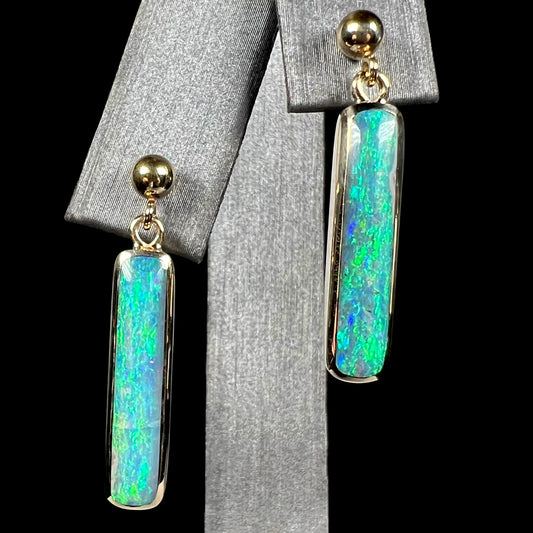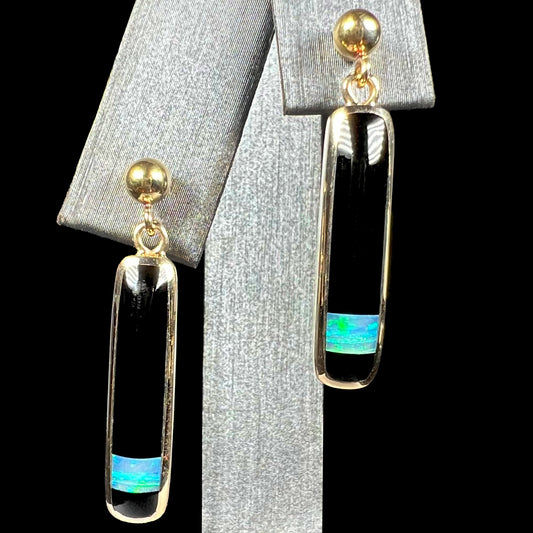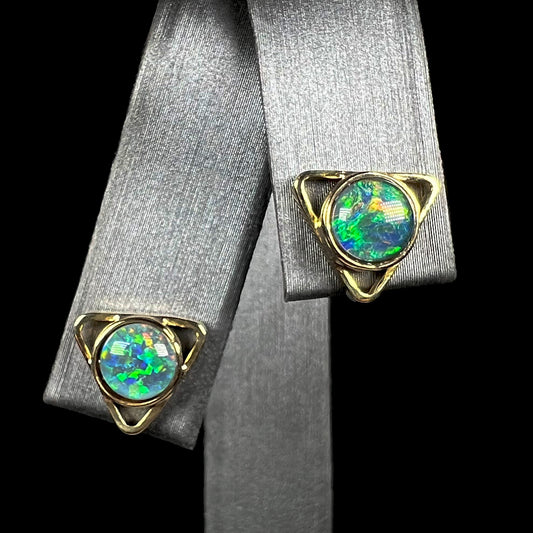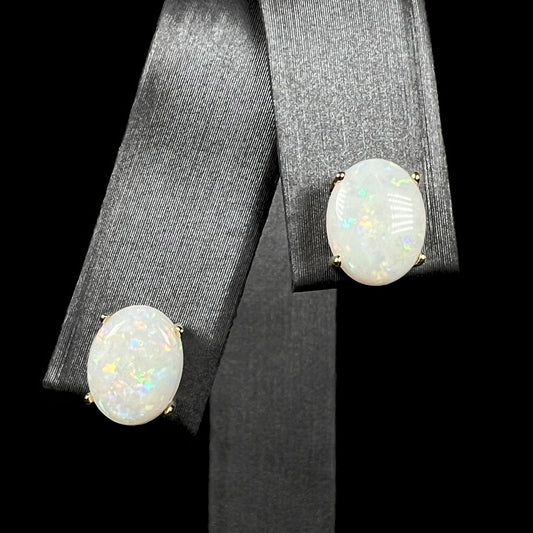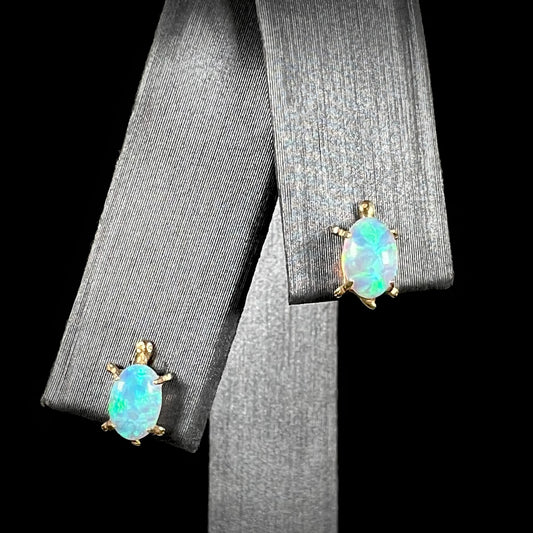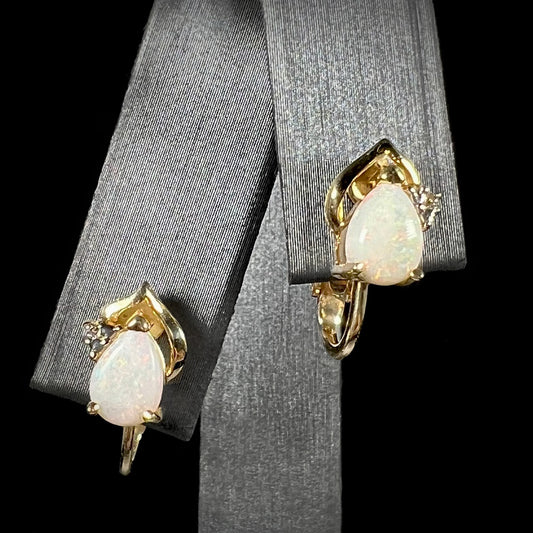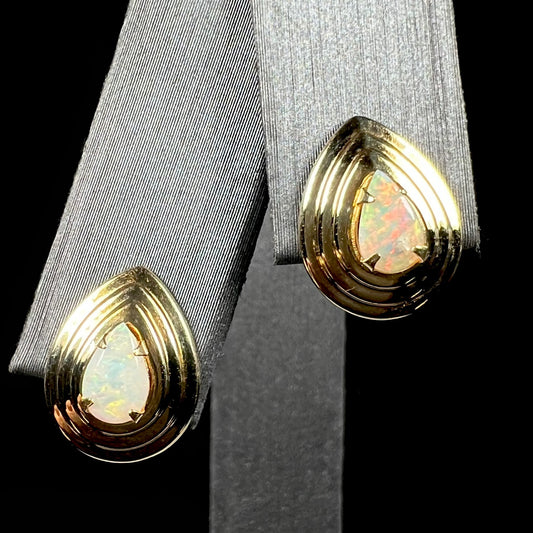
Collection: Gold Opal Earrings

Gold opal earrings carry a presence of their own—framing the face with movement, color, and the quiet weight of solid gold.

Each pair is documented with detailed photography and video, supported by OpalPop’s 14-day return window so you can evaluate craftsmanship, comfort, and balance with confidence.


Gold Opal Earrings: A Deeper Look

OpalPop’s collection of gold opal earrings features matched pairs of natural, assembled, and lab-created opals mounted primarily in solid yellow gold across a range of karat purities, with white and rose gold appearing occasionally over time.  Studs remain the most common format and represent the broadest portion of our selection—from simple everyday pairs to more carefully matched stones.  Alongside studs, you’ll also see dangling drop styles and semi-hoop designs, where movement, balance, and comfort matter just as much as gemstone quality.

In our broader Gold Opal Jewelry collection, we examine gold as a global material—its colors, purities, cultural standards, and hallmark identification.  Here, the focus narrows specifically to earrings: what to consider before choosing a pair, how karat purity affects wear, why matching opals influences price and availability, and what realistic options exist if one earring is ever lost.

Gold Opal Earrings: The Broad Strokes

As karat purity increases, gold becomes denser and softer.  In earrings, that translates to slightly more weight on the earlobe and more gradual wear on mechanical components such as posts, friction backs, and leverbacks.  The differences between 10k, 14k, and 18k are not dramatic—but they are meaningful over long periods of wear.

Metal Allergies and Sensitivities

Unlike rings or pendants, earrings pass directly through the skin.  If you have metal sensitivities, they will typically show up in the ears first.

  • White gold is the most common source of irritation because many alloys rely on nickel to achieve a whiter tone.

  • Lower-karat gold (especially 10k) contains more overall alloy, and copper content can irritate highly sensitive wearers.

If you’re unsure of sensitivities, yellow gold is generally the safest starting point.  Higher karat reduces alloy content overall, making 18k yellow gold the safest in purity terms—though most wearers tolerate 14k yellow gold very well.

The Challenge of Matching Opals

Opal earrings are never simple to produce.  Every natural opal is one-of-a-kind, which means matching two stones closely enough in body tone, brightness, color palette, and pattern requires patience—and often luck.

As stone quality increases or varieties become rarer, matching becomes exponentially more difficult and more costly.  This is one reason lab-created opals and assembled stones (doublets and triplets) are common in earrings: they are easier to match and can be a practical choice for buyers who prioritize visual symmetry and wearability.

A Note About Natural Inclusions

Because matching small, bright natural opals is difficult, it is common to see natural crack or fissure inclusions in stones set in earrings—particularly in 10k and 14k gold pieces featuring strong play-of-color.

While such inclusions are typically undesirable in high-impact jewelry like rings, earrings face far fewer sharp knocks.  Those inclusions often make it possible to match stones that would otherwise never appear as a pair, opening up more options for wearable, balanced designs.

Popular Gold Opal Earring Styles

Gold Opal Studs

Studs are the most classic form of opal earrings—clean, versatile, and appropriate for nearly any setting.

Gold opal studs span nearly every combination of:

  • opal body tone and color profile
  • brightness and pattern
  • shape and size
  • gold karat purity and gold color

Most use simple posts with friction (butterfly) backs.  Screw backs are typically a custom security upgrade rather than a default feature.

A practical note: with any friction-back earring—especially softer 18k—check occasionally that the back still grips firmly.  If the tension loosens, the “wings” can often be gently squeezed to restore a tighter fit.

Dangling Gold Opal Drops

Drop earrings introduce motion.  Even subtle movement changes how an opal interacts with light, particularly while walking or turning the head.

Common findings include:

  • friction-back posts with a gold ball or decorative element and a suspended opal below
  • open-wire shepherd’s hooks
  • closed leverbacks, which are typically the most secure option

A modern, practical consideration: face masks.  Mask straps can catch shepherd’s hooks during removal and unexpectedly dislodge earrings.  If you wear drops regularly, leverbacks provide additional security.

Most commercial findings are produced in 14k gold because it balances durability and availability, though 10k and 18k options exist.

In the market, you’ll commonly see:

  • subtler 10k dangles set with Australian white opals
  • finer 14k examples featuring Australian crystal opals, Ethiopian opals, or matched boulder opal pairs split from a single stone

Gold Opal Semi-Hoops

Semi-hoops offer the presence of a hoop while presenting a curved, stone-lined front.  Because multiple opals are used per earring, consistent matching across several stones becomes especially important.

Common patterns include:

  • 1980s–1990s vintage pieces featuring Australian crystal opals in 14k
  • modern 10k versions set with Ethiopian opals or lab-created material

Semi-hoops range from lightweight daily styles to heavier statement versions, which is why they appear across a broad spread of price points.

If You Lose an Earring

Losing one earring is frustrating—but it does not automatically render the remaining piece unusable.  There are realistic paths forward.

Recreating the Match

Commissioning a jeweler to duplicate the missing earring is possible—but typically the most expensive route.

Many commercial opal earrings are produced in quantity, often overseas, which keeps pricing efficient.  Custom labor to recreate a single earring rarely benefits from that efficiency.  In many cases, the labor alone exceeds what the original pair cost.

Matching the opal is the greater challenge.  Subtle stones are easier; rarer varieties—such as vivid black opals—can be extremely difficult to replicate.  This route makes the most sense only when the pair carries strong sentimental value.

Converting to a Pendant

In most cases, this is the most practical solution.

A jeweler can often fabricate and attach a bail using the existing gold post or finding, allowing the piece to be worn on a chain.  Labor is typically modest, and additional gold is often unnecessary.

Opals with natural fissures remain safe in pendant form, since pendants face far less impact risk than rings.

Converting to a Ring

This is possible, though more involved.

Creating a ring requires fabricating a shank, adding gold, and precise sizing work.  It makes the most sense when the opal is higher-end and structurally sound.  If inclusions are present, converting to a pendant is usually the wiser option for both durability and cost.

Dig Deeper

Explore more curated collections similar to Gold Opal Earrings: