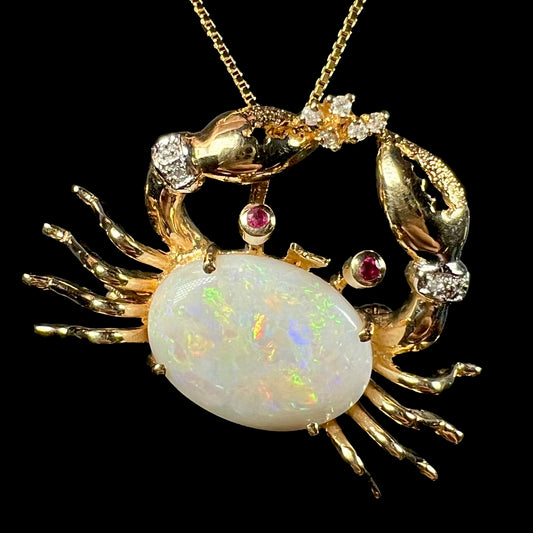
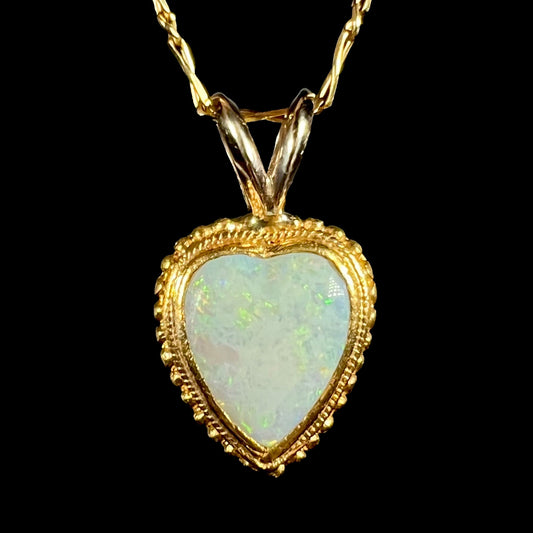
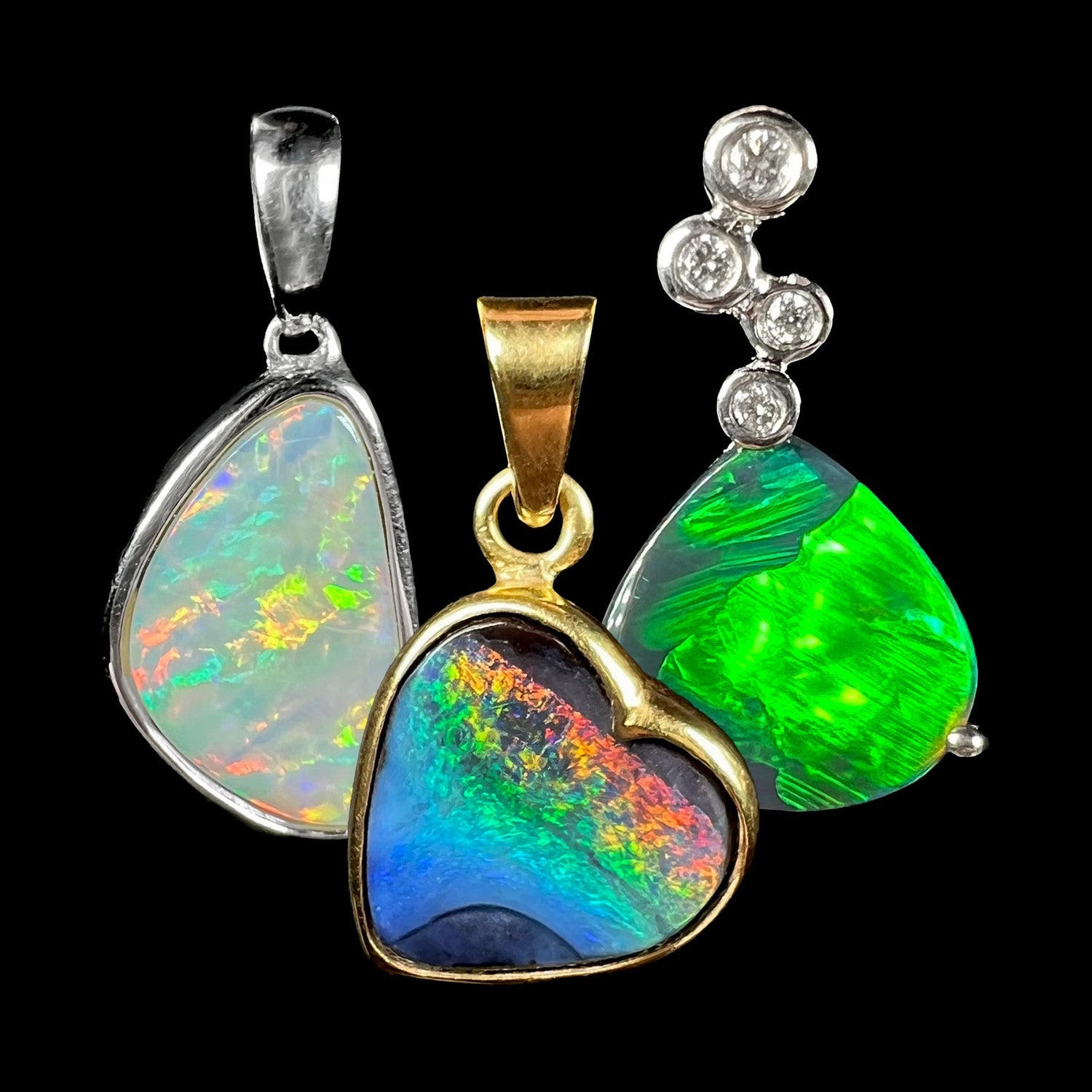
OpalPop’s collection of 14k gold opal necklaces features a wide variety of pendants incorporating solid 14k gold elements—whether crafted entirely from 14k gold, mixed karat purities, or mixed metals. Pieces range from one-of-a-kind artisan creations to commercially-produced fashion jewelry spanning multiple eras. Gold-plated and gold-filled pendants are intentionally excluded from this collection.
Every OpalPop pendant includes a presentation chain so complete necklaces can be enjoyed immediately out of the box. Most presentation chains are sterling silver—gold-plated when necessary to complement yellow gold pendants—though select pieces include matching 14k gold chains or alternative cord options. Specific chain details are always documented within each product description.
In our overarching Gold Opal Necklaces collection, we take a broad look at gold as a jewelry metal, touching on the wide range of available colors and karat purities. In our 14k Gold Opal Jewelry guide, we look more closely at 14k gold itself, discussing its history and prevalence as the standard benchmark of the American jewelry market. Here, the focus narrows specifically to 14k gold opal necklaces: how they wear over time, proper care considerations, popular pendant styles commonly encountered on the market, and notes regarding 14k gold chain clasps.
14k Gold Opal Necklaces: The Benchmark of the American Market
14k gold remains the undisputed standard of the American jewelry market, occupying the middle ground between the rich appearance of higher-karat gold and the added durability of lower-karat alloys. Because of this balance, American jewelers offer 14k gold in the widest range of opal necklace styles on the market—from simple bezel-set solitaires to intricate diamond halo pendants. If a designer chooses to manufacture an opal pendant in only one purity, that purity is most often 14k.
The same principle applies to chains. Large suppliers such as Stuller and Quality Gold overwhelmingly produce their catalog offerings in 14k, with 10k and 18k options occupying only a small fraction of the market.
Wearing and Caring for 14k Gold Opal Necklaces
With any necklace, a single point of failure can result in the loss of both the pendant and chain. Understanding how necklaces wear over time is therefore critical—particularly for finer opal pieces.
While many factors influence longevity, chain thickness is among the most important. 14k gold chains range from extremely delicate sub-millimeter designs to heavy men’s chains. Because many opal pendants are lightweight and refined, they are frequently paired with thinner chains that require additional mindfulness.
Remove Before Sleeping & Thin Chains Before Showering
It is always recommended to remove 14k gold necklaces before sleeping. Wear does not stop simply because the wearer is asleep; unexpected tension can occur to both the pendant and chain throughout the night.
Thin chains should also be removed before showering. Water pressure against the back of the neck can place unnecessary stress on delicate links, particularly when combined with the weight of a pendant.
After removing a necklace, it is good practice to close the clasp before setting the chain down. This greatly reduces the risk of knotting—a notorious issue with thinner chains. Long-term storage should also avoid hanging necklaces whenever possible, as gravity and pendant weight gradually stress the chain over time.
Care should additionally be taken when setting down the pendant itself. Opals are delicate stones and should never be placed face-down on abrasive surfaces or handled carelessly.
Checking 14k Pendants & Chains for Wear
One of the most important areas to inspect on a pendant is the bail—the section where the chain passes through the pendant. Over many years of wear, chains slowly “saw” through gold bails, eventually creating visible grooves or notches where metal has worn away.
Chains themselves can develop similar wear patterns near clasps and connecting points. Professional jewelers are trained to identify these high-risk wear areas and can often repair them before failure occurs.
Mixing metals and karat purities can also influence wear rates. Harder metals wear softer metals faster:
- 10k gold is harder than 14k
- 14k gold is harder than 18k
When the pendant bail is harder than the chain, the chain generally wears faster. When the chain is harder than the pendant, the bail becomes the primary wear point.
Water & Chemical Exposure Notes
Most opal pendants are safe to wear around water, though a few important exceptions exist. Ethiopian opals, opal doublets, and opal triplets should not be exposed to moisture.
Perfumes, lotions, hand sanitizers, and chemical cleaners should also be kept away from all opal varieties whenever possible. It is always safest to apply these products before putting on jewelry.
Can Real 14k Gold Chains Turn My Neck Green?
To the surprise of many buyers, yes—some genuine solid 14k gold chains can occasionally turn a wearer’s neck green. This occurs most commonly with vintage 14k yellow gold necklaces and 14k rose gold necklaces that contain higher copper contents. Individual skin chemistry also plays a role.
While visually alarming, this harmless reaction is not necessarily an indicator of fraud or misrepresentation and can typically be washed away easily.
There are two additional reactions worth distinguishing from true skin discoloration:
- Dirty chains or leftover polishing compounds can leave dark residue along the back of the neck.
- Some wearers experience nickel sensitivities from 14k white gold necklaces, causing itching, rashes, or irritation after prolonged wear.
For individuals sensitive to nickel alloys, white gold pendants are generally safest when worn on sterling silver chains.
Popular Styles of 14k Gold Opal Pendants
Because 14k gold dominates the American jewelry market, there is no single defining style of 14k gold opal pendant. Certain design trends, however, appear repeatedly across different eras.
Handmade 14k Gold Opal Solitaire Pendants
Jewelers have hand-fabricated opal pendants for centuries. Most modern handmade 14k examples are relatively minimalist in design: gold wire or sheet metal formed into bezels, soldered to bails, and custom-fit around individual stones.
These designs are particularly compatible with freeform opal cuts and are generally safer to produce than highly complex mountings that expose the stone to repeated heat or stress during manufacturing.
Commercially-Produced 14k Gold Opal Pendants
Beginning in the 1980s, many large jewelry companies shifted manufacturing to overseas production hubs in order to lower labor costs and increase production scale—a practice that continues today.
Both 10k gold opal necklaces and 14k gold opal necklaces became widely mass-produced during this period. Earlier commercial designs commonly featured Australian white opals and lab-created opals due to their consistency across large production runs. Following major African discoveries beginning in 2008, Ethiopian opals became increasingly common in commercially-produced pendants.
Most commercially-produced 14k gold opal pendants are lightweight and designed for thinner chains. Many are under named designer brands—like Cirari and Le Vian—bearing a designer’s hallmark stamp.
Vintage Modernist 14k Gold Boulder Opal Pendants
One of the most recognizable categories of vintage American opal jewelry emerged during the 1980s and 1990s Australian opal boom. These pendants frequently featured asymmetrical Modernist-inspired designs mounted with freeform Australian boulder opals, diamond accents, and enhancer bails.
Yellow gold dominated the style, though both 14k and 18k gold opal pendants were produced. Many 14k examples feature high-grade assembled Australian boulder opal doublets rather than solid boulder opals.
Because these pendants are frequently misrepresented in secondary markets, understanding how to identify doublets is important. Boulder opal doublets typically display:
- flatter surface profiles,
- broader flashes of color,
- and no visible ironstone matrix within the face of the stone.
The simplest way to confirm authenticity is by viewing the stone from the side, though many bezel-set designs intentionally conceal this angle.
Common 14k Gold Clasp Designs
Different styles of clasps are often associated with different categories of chains and can occasionally offer clues regarding a chain’s intended use or quality level.
Lobster Clasps
Most moderate-weight 14k gold chains utilize lobster clasps. These are widely regarded as the most secure common clasp style due to their strength, reliability, and ease of operation.
Spring Ring Clasps
Lightweight 14k chains frequently use spring ring clasps, also called “C clasps.” These are cost-effective and historically very common across many eras of jewelry production. While generally reliable, their internal spring mechanisms are more prone to eventual failure than lobster clasps.
Box Clasps & Barrel Clasps
Heavier chains—particularly men’s chains—often implement box clasps or barrel clasps. Box clasps involve a tongue mechanism that locks into place and frequently incorporate additional safety latches for added security. Barrel clasps operate on a threaded twisting mechanism and are commonly encountered on heavier or more decorative chain styles.