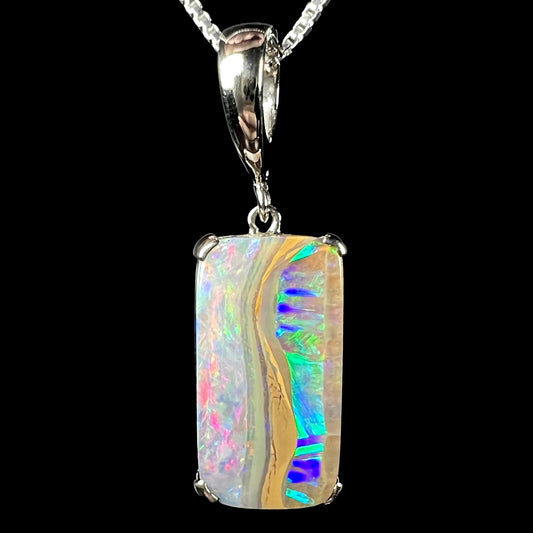
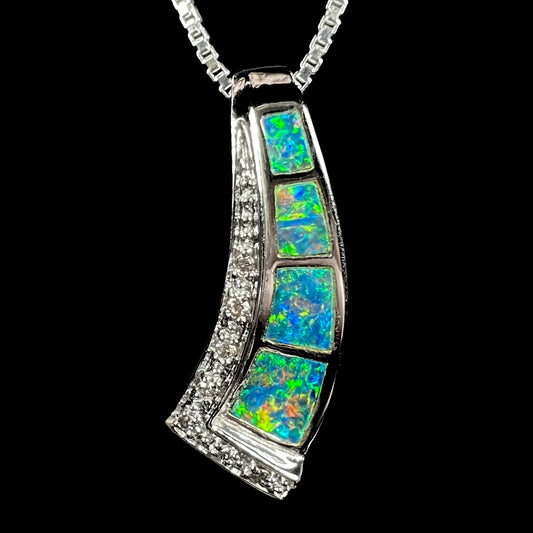
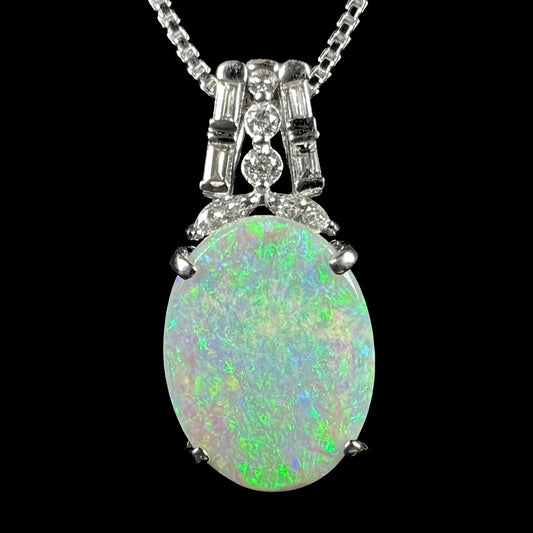
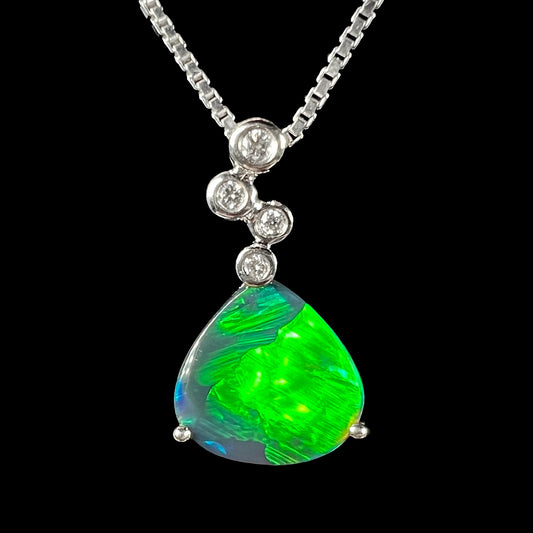
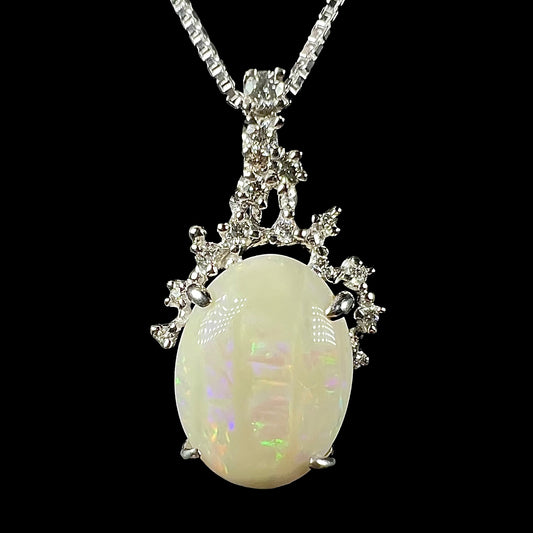
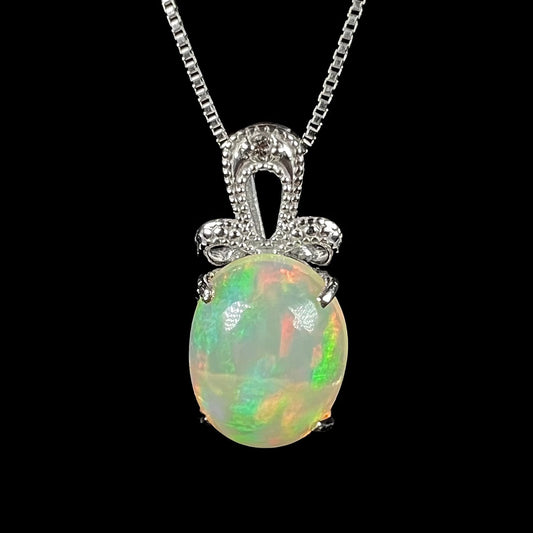
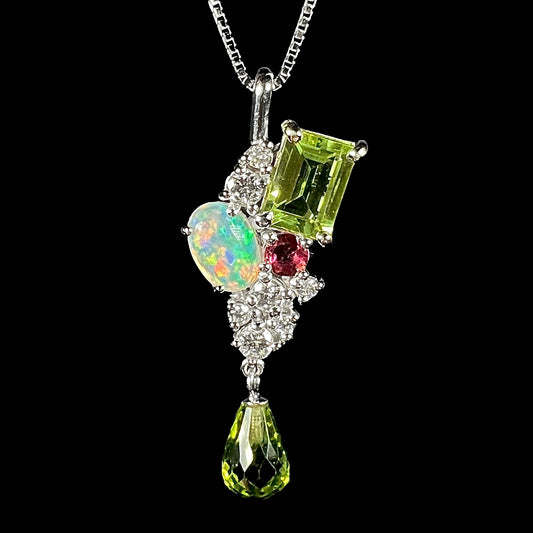
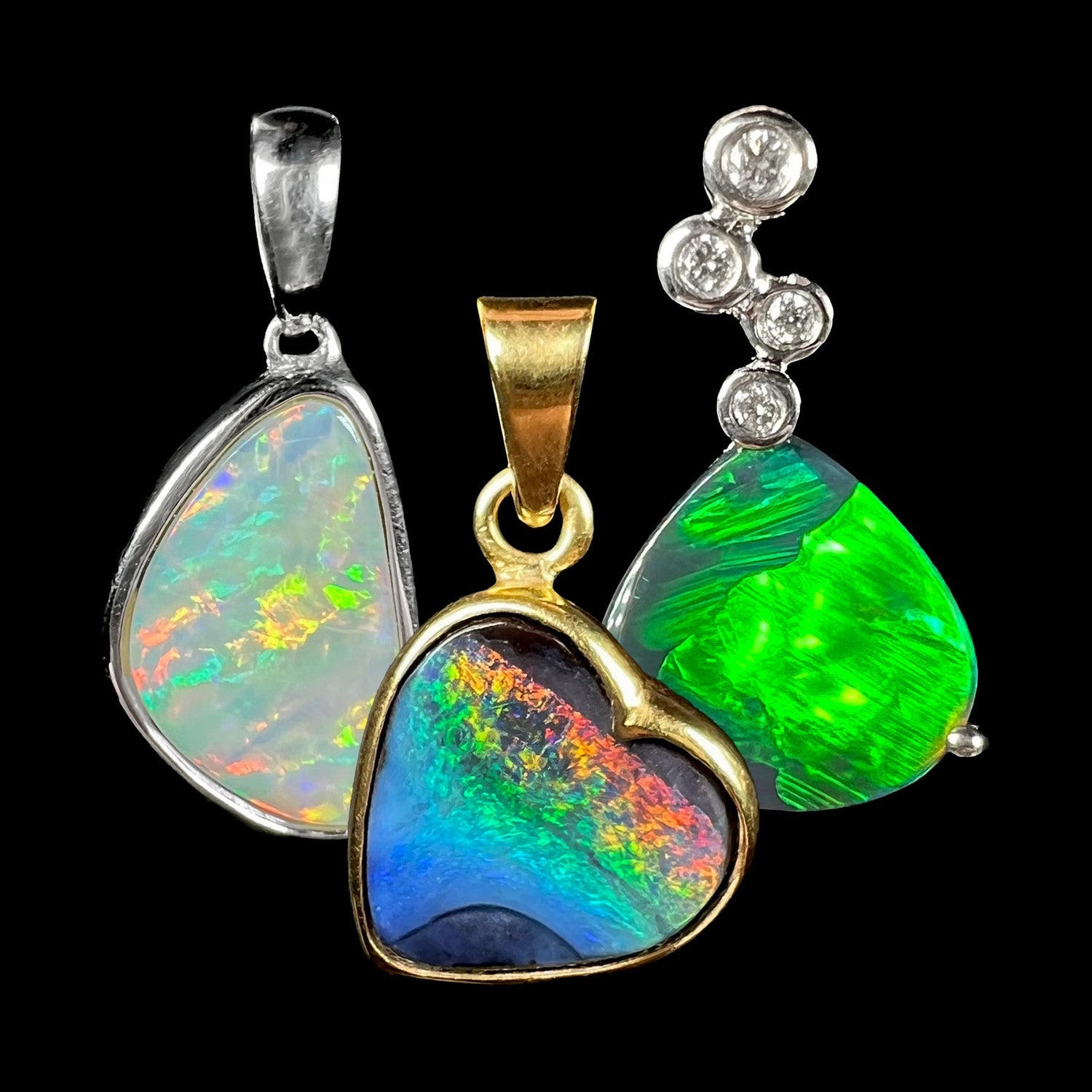
OpalPop’s collection of white gold opal necklaces features pendants crafted in a range of karat purities, sourced from estates and custom jewelers around the world. Most include complimentary sterling silver presentation chains so they can be worn immediately, while some are paired with matching white gold chains. Specific chain details are listed on each product page.
In our broader Gold Opal Necklaces guide, we explain that “gold” encompasses many different colors and purities. In our White Gold Opal Jewelry guide, we examine white gold’s modern history and growing dominance in the American jewelry market. Here, the focus narrows to necklaces specifically—from allergy considerations and the kind of statement white gold makes, to design trends, chain realities, and rhodium plating over time.
Nickel Sensitivities and White Gold Necklaces
Before anything else, prospective buyers should first consider whether they have a nickel sensitivity.
Nickel is the primary alloy used in most American white gold, and some individuals experience itching, rashes, or irritation after prolonged contact. If you have worn white gold jewelry before without issue, this is usually not a concern. For first-time buyers, the most reliable method is a professional allergy test through a dermatologist.
Some buyers instead try at-home exposure methods, such as wearing a borrowed white gold item for several days or taping a nickel coin to the skin to observe for reaction. Any redness, itching, or irritation suggests sensitivity.
That said, nickel sensitivity does not automatically rule out white gold pendants. Pendants can often still be worn safely if suspended on sterling silver or platinum chains long enough to keep the piece resting against clothing rather than skin.
White gold chains, however, should generally be avoided by those with nickel allergies, as they remain in constant contact with the neck.
The Aesthetic of White Gold Opal Necklaces
Where rings are primarily enjoyed by the wearer, necklaces are outward-facing pieces, perceived mostly by others.
White gold creates a different kind of impression than yellow gold. It carries less overt visual weight, signaling luxury in a quieter and less immediately recognizable way. Because it resembles metals such as sterling silver, stainless steel, or platinum, white gold blends more naturally into everyday settings.
This subtlety also makes white gold necklaces less conspicuous in public. Where yellow gold may visibly signal value from a distance, white gold is less likely to attract unwanted attention in ordinary environments.
That discretion is not absolute, however. Bright opals, large stones, and diamond accents can still draw notice regardless of metal color.
Design Trends in White Gold Opal Pendants
Although white gold has existed since the early 20th century, most examples found on today’s market are relatively modern. Its strongest growth came in the 1990s and 2000s, when it overtook yellow gold in popularity across much of the United States.
Lingering Modernism in 1990s White Gold Pendants
The 1990s marked a major turning point for white gold. As its popularity surged, jewelers carried forward many design influences from the opal boom decades of the 1970s and 1980s.
Modernist asymmetry remained popular, though forms became smaller and more restrained than earlier bold designs. Folded ribbon motifs in 14k white gold were especially common, often inlaid with Australian opals, while 18k white gold versions were reserved for finer material.
Minimalist White Gold Pendants in the 2000s
As gold prices rose through the 2000s, pendant designs became lighter and more minimal.
Australian white opals remained common early in the decade, but the discovery of stable Ethiopian opal in 2008 changed the market significantly. Ethiopian material quickly became widespread in 10k white gold pendants in the United States, while parallel markets such as Japan continued favoring higher-karat white metals that followed the same dainty visual aesthetic.
Custom White Gold Pendants in the 2010s
Custom jewelry surged in popularity during the 2010s, and pendants became one of the most common formats for bespoke work.
Because pendants require less structural engineering than rings, jewelers had broad design freedom. Bezel-set solitaire pendants remained the dominant format, while freeform cluster designs incorporating diamonds, opals, and mixed gemstones also became increasingly common. White gold’s cool neutrality reinforced the sleek, modern aesthetic favored during this period.
White Gold Chains: What Buyers Should Know
White gold chains are far less common than yellow gold chains, with narrower selections in style, width, and weight.
They are also expensive. Because chains require substantial metal weight and labor-intensive construction, even lightweight white gold chains can easily exceed the cost of the pendant they carry. For this reason, a white gold chain is best viewed as its own long-term investment rather than an accessory tied to a single pendant.
Nickel-based white gold alloys also provide greater hardness than yellow gold, giving white gold chains strong wear resistance over time.
At OpalPop, we recommend choosing repair-friendly link styles such as:
- Box
- Curb
- Cable
- Solid rope
- Wheat
These can usually be repaired by local jewelers if damaged.
Styles such as snake, omega, herringbone, and hollow rope are far more difficult to repair if kinked or crushed, and are often poor long-term choices in white gold.
For many buyers, sterling silver remains the most practical alternative. Sterling silver chains are affordable, easily replaced, available in many lengths and styles, and are softer than white gold—reducing wear on a pendant’s bail (the loop that the chain runs through) over time.
Rhodium Plating White Gold Necklaces
What Is Rhodium Plating?
White gold naturally carries a faint yellow tint, especially in higher purities. To create the bright white finish consumers expect, most white gold jewelry is coated in rhodium.
Rhodium is a hard, reflective platinum-group metal that:
- Whitens the surface
- Improves scratch resistance
- Creates a more uniform finish
This plating wears over time and eventually requires professional renewal. Daily wear, friction, and even skin chemistry influence how quickly that happens.
How Rhodium Wears on Pendants vs. Chains
Pendants and chains wear differently.
On pendants, rhodium loss occurs primarily on the back surface where the piece rubs against clothing or skin. The visible front face often remains bright for many years, which is why most collectors never bother replating pendants unless damage or refinishing is already being done.
Chains wear much faster. Every movement against the neck, clasp friction, and repeated sliding through a pendant bail gradually erodes the plating. Over time, a white gold chain may begin to show a faint warmer undertone before the pendant itself does.
Between 2016 and 2026, rhodium prices fluctuated dramatically—from roughly $625 per ounce to over $29,000. In early 2026, average prices hovered around $10,000 per ounce.
Although jewelry plating uses only microscopic amounts of rhodium, larger surface areas—especially chains—make replating increasingly costly. For this reason, some modern white gold chains are nickel plated instead of rhodium plated as a lower-cost alternative.
Whether a worn chain is replated in rhodium, nickel, or left unchanged is ultimately a personal decision.