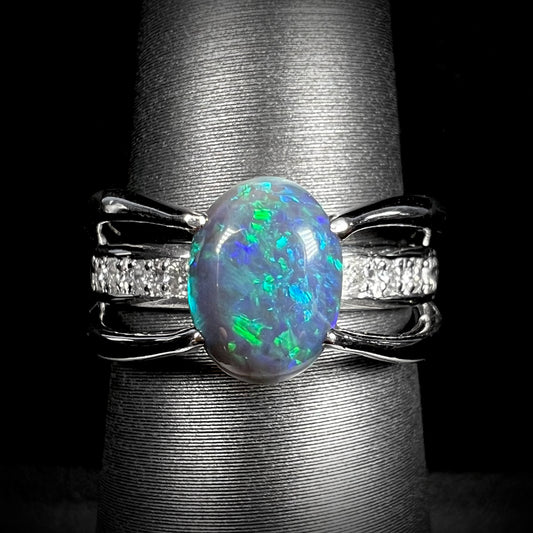
The Empress is a mid-century Shōwa Japanese platinum cocktail ring built around an extraordinary 11.46-carat rectangular Australian light semi-crystal opal, framed by 0.64 carats of natural diamonds. Measuring approximately 22.14 × 12.43 × 5.07mm, the opal has the scale and physical depth of a small tablet, yet its green-dominant play-of-color remains bright and remarkably consistent across its face. Set within an architectural platinum construction measuring just over one inch from end to end, the result reads less like a conventional gemstone ring than an important vintage object.
Approximate current ring size: 4.75 US. Complimentary resizing may be available where technically appropriate; please contact us with your desired size so feasibility can be confirmed before purchase.
An 11.46-Carat Green-Dominant Australian Opal
We conservatively classify the center stone as an N7 light semi-crystal opal. Its body has substantial translucency with a softly smoky, warm cast, allowing light to travel visibly through the considerable depth of the stone while retaining the light body tone expected of its classification. The opal is Australian and is attributed, though undocumented, to Coober Pedy based on its visual characteristics.
Green is the defining color of The Empress, but not a single green. Yellow-green, vivid grass green, blue-green, and cooler teal flashes appear across nearly the entire face, accompanied by blue undertones and delicate touches of yellow and orange. Rather than concentrating its best color into one privileged viewing angle, the opal is notably non-directional: its brightness and extensive play-of-color coverage remain consistent as the hand and viewing position change, with very little of the broad rectangular face becoming visually inactive.
In subdued ambient light, the depth of the translucent body becomes more apparent and the opal takes on a quieter, darker character. Bluish-green flashes remain visible across the stone and intensify immediately as it passes beneath a nearby light source. In ordinary well-lit interiors, multiple shades of green become substantially more active, appearing both alongside and seemingly suspended over one another through the depth of the opal.
Direct artificial light and sunlight reveal its most vivid presentation. The broad face becomes covered in bright, twinkling patches of green and blue, while yellow-green can shift toward delicate yellow and occasional orange. Under certain strong illumination, another effect appears beneath the play-of-color itself: the thick translucent body develops a warm orange-to-pink glow as light passes through it. This is transmitted light within the opal rather than play-of-color.
That translucency creates an especially charming effect when the ring is worn in sunlight. Warm golden light passes through the 5.07mm-thick opal and falls onto the finger below. Because the stone sits high above the hand within an open gallery, that transmitted light has room to spread through the setting rather than disappearing immediately against the skin.
The exposed edges offer smaller details of their own. Green, blue, teal, and occasional warm color remain visible through the sides of the thick cabochon, with different edges revealing distinct arrangements of color and fine pinfire. They are not the primary spectacle of The Empress, but they make the depth responsible for its face-up appearance physically understandable.
Architectural Mid-Century Shōwa Platinum
If the opal provides the immediate spectacle, the setting supplies The Empress with its authority.
Its design is severe, linear, and unmistakably architectural, yet close inspection reveals an unexpected old-world femininity beneath that structure. Fine scrolling filigree sits immediately below the center stone. Beneath it, a projecting intermediate tier holds twenty-four natural diamonds above delicate pierced circular details. Deeper still, a broad ribbed gallery descends toward the finger, creating a vertically layered structure that is far more intricate than the ring initially appears when viewed from above.
Twenty-two round brilliant-cut diamonds and two modified emerald-cut diamonds form this intermediate architectural frame, with a combined weight of 0.64 carat recorded inside the shank. We estimate the diamonds at approximately VS1 clarity and G-H-I color on average. They become particularly lively in strong light, while the two elongated modified emerald cuts create crisp horizontal interruptions within the otherwise round-diamond geometry.
The effect is not that of a conventional diamond halo. Instead, the diamonds extend outward from diagonally opposing portions of the opal like part of the architecture itself, framing the large portrait-like center stone without visually containing it.
The complete ring measures approximately 26.08mm, or just over one inch, from end to end and rises approximately 10.86mm from the finger. With a total mounted weight of 10.36 grams, it has genuine physical substance without losing the delicacy of the fine scrollwork and open construction. That tension—monumental scale against distinctly feminine detailing—is central to The Empress. It feels formal, historical, and commanding without becoming austere.
Hallmarks & Japanese Sourcing
Inside the shank are the marks “P.m,” “11.46,” and “0.64,” recording the platinum designation and the stated weights of the opal and diamonds.
The P.m mark is an older Japanese designation for platinum rather than a modern numerical fineness mark. Because no purity number accompanies it, we do not represent the ring as Pt850, Pt900, or any other specific fineness; the exact platinum content has not been independently assayed. Japanese platinum references likewise caution that older Pm pieces can vary in fineness, making that distinction worth preserving.
Its period design and older platinum marking are consistent with our attribution to approximately the 1950s, during Japan’s mid-Shōwa era.
The Empress was sourced through a private antique-jewelry collector and dealer in Chiba Prefecture, Japan, where the ring was offered within Japan’s domestic market. Its earlier ownership history is undocumented, and we make no claim regarding who originally commissioned or wore it.
That unknown history is, in some ways, part of the fascination. The ring has survived from a period when its scale, labor-intensive platinum construction, and enormous Australian opal would already have made it an exceptional jewel.
Condition, Sizing & Care
The Empress survives in remarkably beautiful condition for a large, high-profile opal ring of its age. The opal retains a clean face-up polish with no crazing or internal cracking observed, and it remains secure beneath four substantial, well-formed prongs.
Several minute nicks are present along exposed upper edges of the opal. They are difficult to see without close inspection and favorable lighting and do not materially affect the face-up presentation. We observe no cracking extending from them into the stone. One narrow rib within the side gallery also sits slightly out of alignment, consistent with vintage wear. Fine lines visible where the shoulders meet the shank are original construction joins rather than cracks in the platinum.
The 11.46-carat figure is the weight recorded inside the ring rather than a present loose-stone measurement. Because those minute edge nicks are present, the opal’s current weight could be fractionally lower than the historic inscribed figure. We have not removed this large vintage opal from its setting simply to reweigh it.
At approximately size 4.75 US, The Empress is unusually small in its present form relative to its enormous face-up scale. Please contact us regarding resizing before purchase; complimentary resizing may be available where the requested alteration is technically appropriate. For the right wearer, its present proportions also create the unusual possibility of wearing The Empress as a large vintage opal pinky ring.
Its 5.07mm depth gives the opal meaningful physical substance, but that should not be mistaken for invulnerability. The Empress remains a high-profile ring with exposed opal edges and is best suited to mindful, occasional wear. We recommend removing it for exercise, housework, gardening, lifting, or other situations in which the stone could be struck. An Australian opal of this scale, condition, translucency, and color coverage would be exceptionally difficult to replace.
The Empress ultimately does not require specialist knowledge of opal to make sense. Its importance is immediately legible: an enormous rectangular Australian opal, broad and consistent green play-of-color, an elaborate one-inch mid-century Japanese platinum structure, and the unmistakable presence of a jewel made in another era. Closer examination rewards the collector with the layered gallery, transmitted light, exposed edge color, old platinum workmanship, and remarkable survival of the stone itself.
For the collector drawn to jewelry with history, scale, and individuality, whether self-chosen or given as an exceptional gift, The Empress offers something more difficult to quantify than carat weight alone. It has the presence of an object that can hold its own in sophisticated company without explanation, while retaining the intimacy of a vintage jewel whose finer details only reveal themselves once it belongs to you.