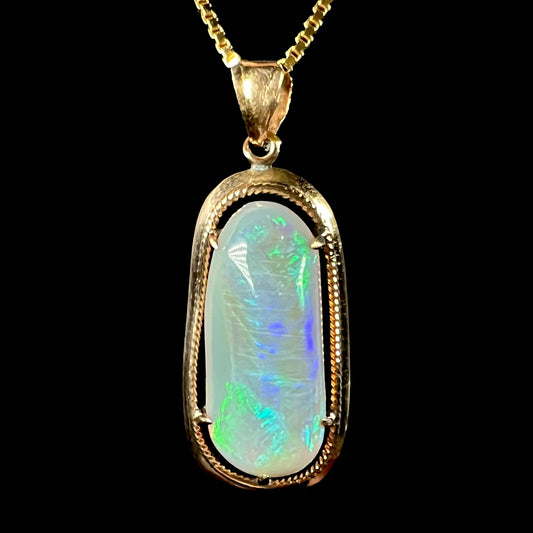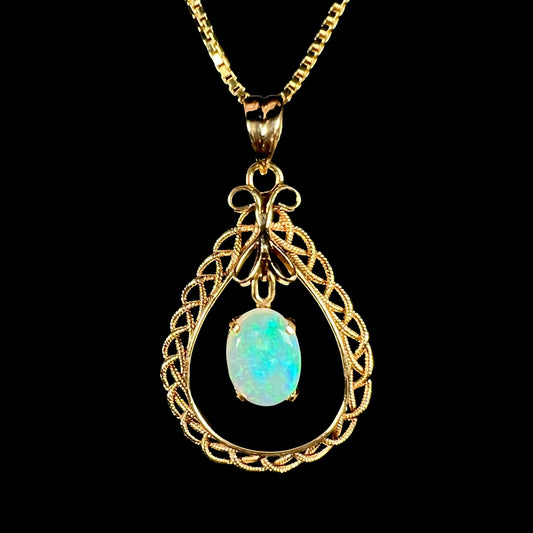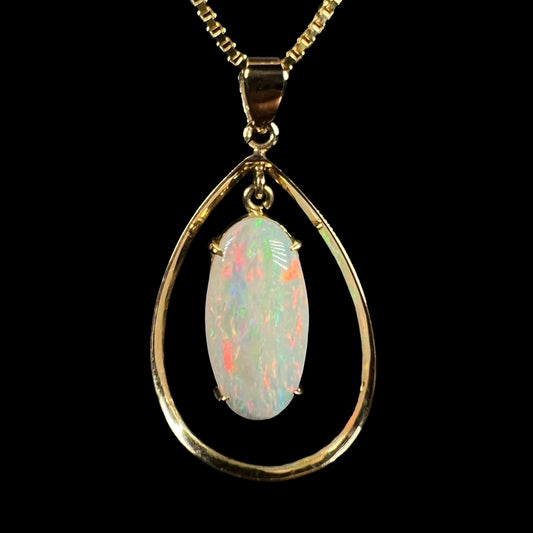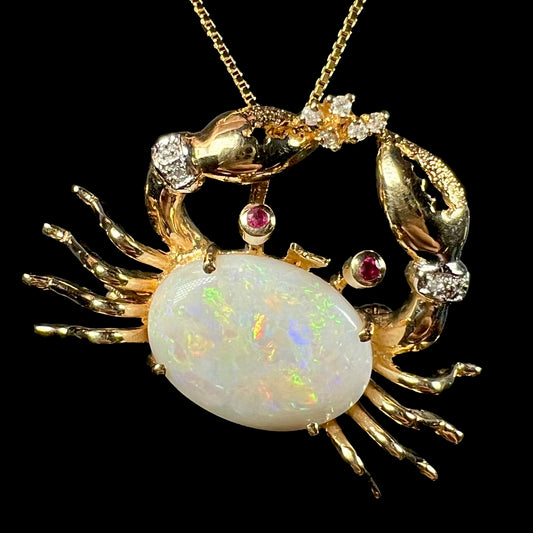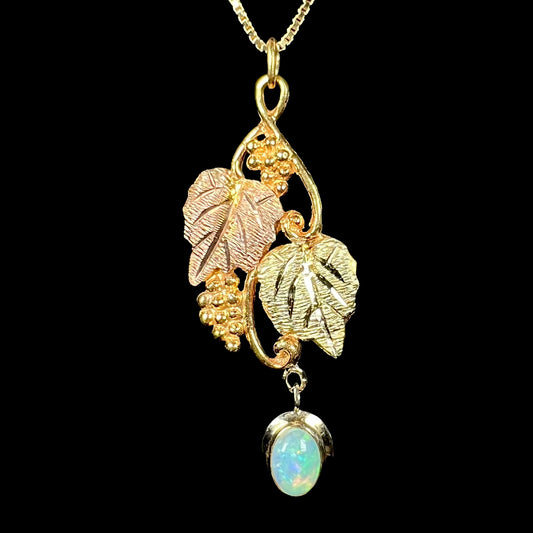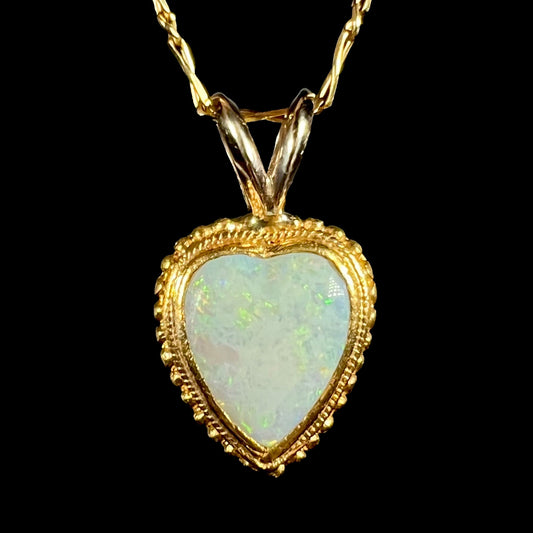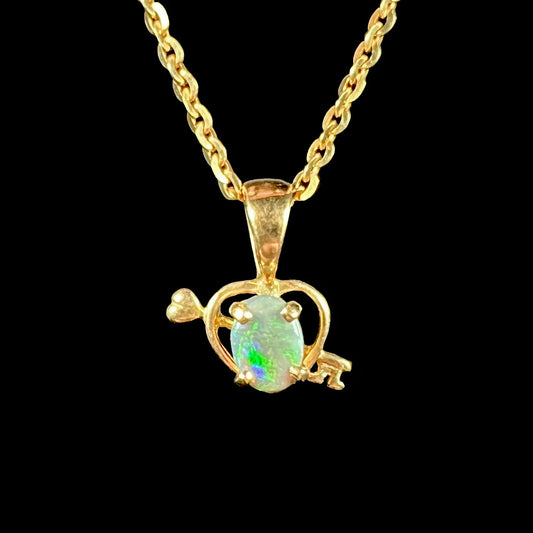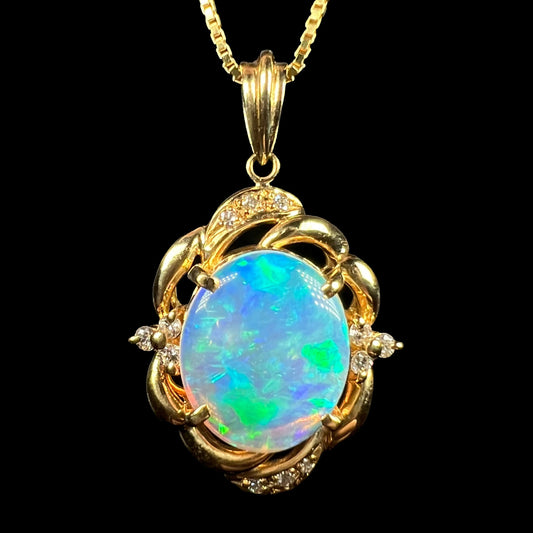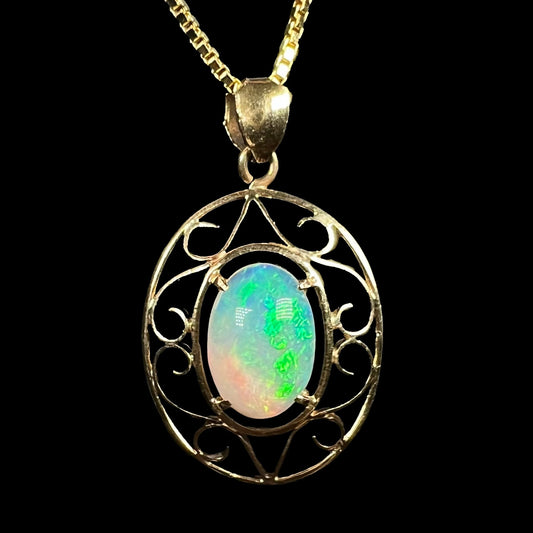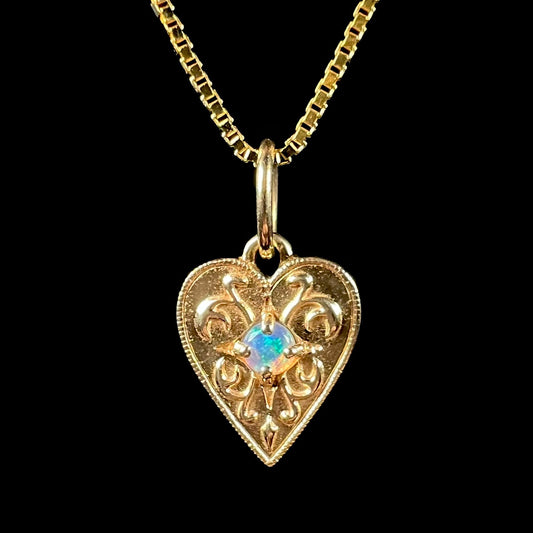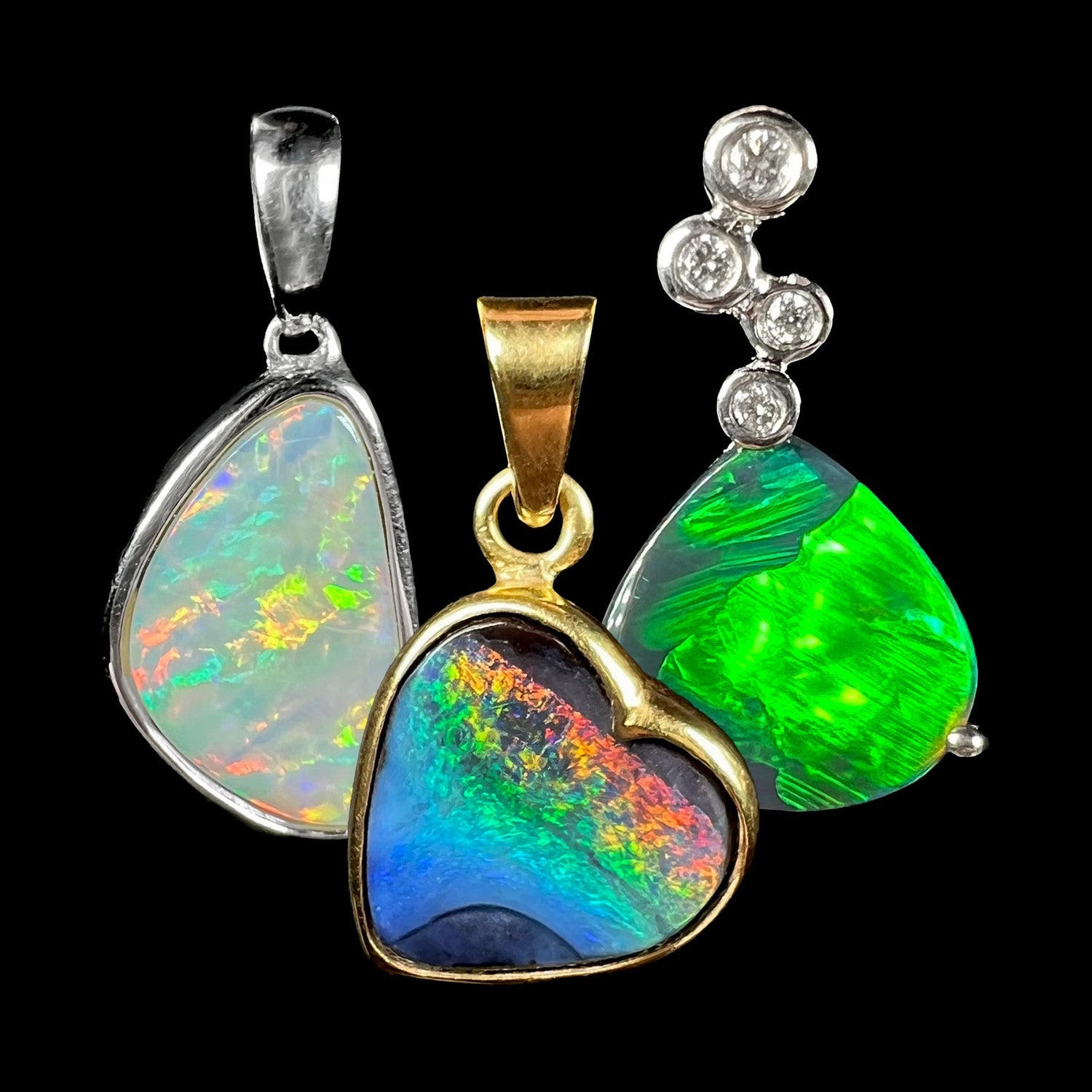
Collection: Yellow Gold Opal Necklaces

Gold, As It Has Always Been.

Yellow gold opal necklaces carry a visible weight—where color, material, and scale are not background details, but part of the impression they make.


Yellow Gold Opal Necklaces: A Deeper Look

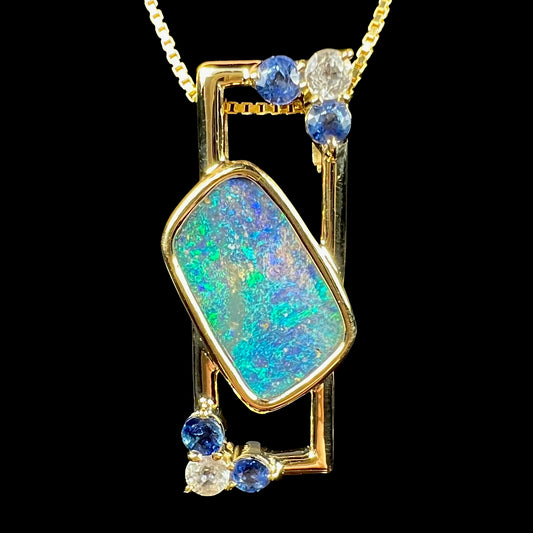
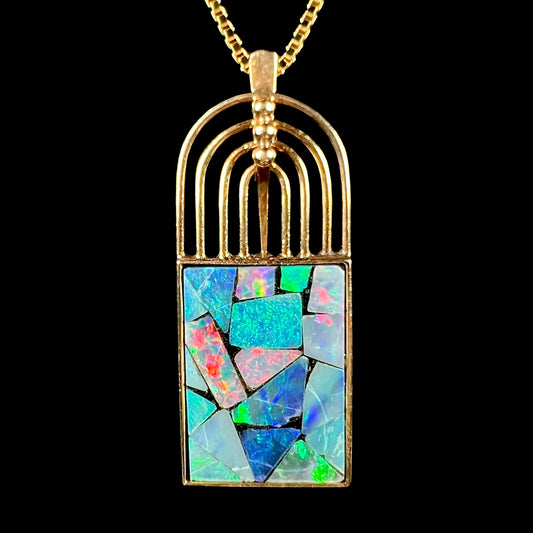
OpalPop’s selection of yellow gold opal necklaces centers on pendants crafted across a range of karat purities—from occasional English and Australian 9k pieces to high-end 18k designs.  These pendants are sourced from modern artists, vintage estates, and auction houses, with many imported from around the world.

Vintage pieces make up a significant portion of the collection.  Common styles include Japanese Mid-Century pendants of the 1960s, bold Modernist designs of the 1980s, and contemporary minimalist yellow gold work.  Yellow gold–filled and plated pendants are intentionally excluded, allowing shoppers seeking solid gold to browse with confidence.  On occasion, sterling silver pendants incorporating solid yellow gold elements may also appear.

Every OpalPop pendant includes a presentation chain, allowing it to be worn immediately.  Most are yellow gold–plated sterling silver selected to match the piece, while some pendants are paired with solid yellow gold chains.  Specific chain details are listed on individual product pages.

In our broader Gold Opal Necklaces collection, we explore how gold functions as a system—defined by color, purity, and perception.  In the Yellow Gold Opal Jewelry guide, we focus on yellow gold’s cultural role and how karat purity influences its color.

Here, the emphasis shifts to presence.  Necklaces are outward-facing pieces, and yellow gold has a direct impact on how they are perceived—along with the design traditions and practical considerations that come with them.

Yellow Gold Opal Necklaces: Presence and Visibility

Unlike rings or bracelets, necklaces are primarily seen by others.  Their impact is external.

Yellow gold has long carried a visible association with wealth and status.  Its color is immediately recognizable, and across cultures it has been used as a direct signal of value.  When worn as a necklace—where the piece is positioned openly on the body—that signal becomes more pronounced.

Whether subtle or bold, yellow gold is rarely neutral.  It draws attention, whether intended or not.

Safety and Context for High-Visibility Gold

Because of that visibility, it is worth considering where and how yellow gold necklaces are worn.

With rising gold prices, visible displays of value can carry risk to a wearer in certain environments.  Being mindful of setting and context is a practical consideration for long-term ownership.

Design Trends in Yellow Gold Opal Pendants

Jewelry trends are cyclical, and yellow gold is closely tied to specific periods of prominence.  In the United States, its association with earlier decades has contributed to its current “vintage” or “retro” perception.

Many yellow gold opal pendants on the market today are, in fact, original pieces from those eras.  Below are several key periods that continue to shape what is available.

The Australian Opal Boom — 1970s to 1980s

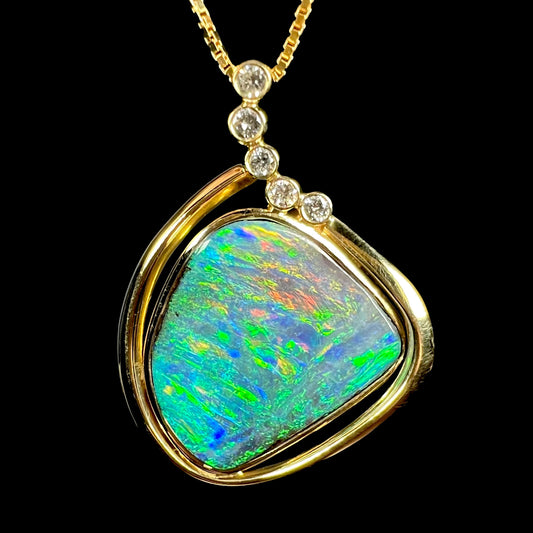
The 1970s and 1980s marked a major expansion of the Australian opal market in the United States.  Large, high-quality stones—particularly boulder opals and white opals—became widely available to designers.

This period overlapped with strong demand for yellow gold, resulting in pendants that were often large, expressive, and materially substantial.  Many designs drew influence from the earlier Modernist movement, favoring asymmetry, organic form, and artistic statements.

High-grade stones were frequently set in 18k yellow gold, while similar designs in 14k yellow gold often incorporated opal doublets that visually approximated solid material.  Pendant enhancer bails—designed to clip onto thicker chains or pearls—were also common.

Mid-Century Opal Pendants — 1940s to 1960s

Following the white gold dominance of the earlier Art Deco era, the Mid-Century period saw a return to yellow gold in American jewelry.

Atomic-inspired designs featuring clusters of Australian white opals were widely produced in 10k yellow gold and 14k yellow gold, particularly by U.S. East Coast manufacturers.

At the same time, Japan experienced a post-war jewelry boom, favoring Australian boulder opals and fine crystal opals.  Japanese Mid-Century pendants often featured lightweight solitaire designs with hand-worked filigree detail, alongside more elaborate pieces combining 18k yellow gold and diamond accents.

Contemporary Yellow Gold Pendants — 2000s to Present

While white gold has once again dominated much of the 21st century, yellow gold remains present through both custom work and commercial production.

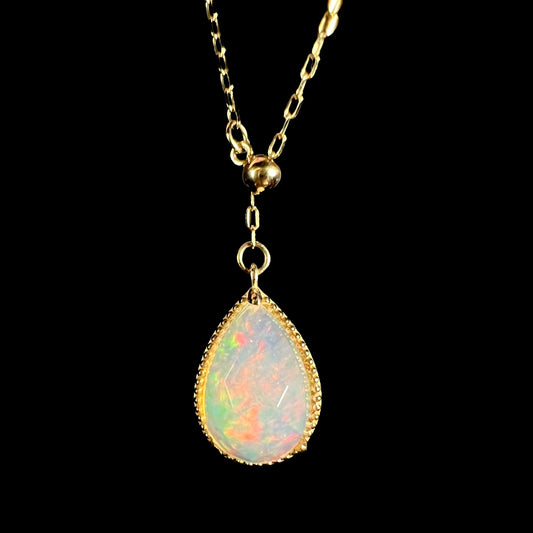
Rising gold prices and reduced availability of large Australian stones have shifted design trends.  The discovery of Ethiopian opal in the late 2000s introduced new material into the market, influencing both high-end and commercial jewelry.

Custom Yellow Gold Pendants

Custom design saw significant growth in the 2010s.  In the United States, 14k yellow gold remains the most common choice for bespoke pendants, balancing cost, durability, and color.

The most frequently encountered design is also the simplest: a bezel-set solitaire with a fixed bail.  This format appears across purities, including 10k yellow gold and 18k yellow gold, depending on budget and preference.  Imported 9k pendants from Australia and the United Kingdom are also occasionally seen.

Commercial 10k Yellow Gold Opal Designs

Large-scale manufacturers have focused on lightweight, cost-efficient designs, often produced overseas in manufacturing hubs like Thailand and China.  These pieces are commonly made in 10k yellow gold and set with Ethiopian or lab-created opals, offering consistency and accessibility at scale.

Yellow Gold Accents in Silver

Some designs incorporate solid yellow gold elements into sterling silver settings.  This may include yellow gold bezels, accent plates, or decorative details, creating contrast and a sense of quality while keeping overall cost lower.

Yellow Gold Chains: Expectations and Care

Solid gold chains are often more expensive than the pendants they accompany.  Even lightweight designs require a significant amount of material, making them a separate investment.

For this reason, many pendants are paired with gold-plated or gold-filled chains.  At OpalPop, presentation chains are typically gold-plated sterling silver, selected to be compatible for those with sensitive skin.

When wearing a chain, removing it before sleep helps reduce wear on both the chain and the pendant’s bail.  When storing, fastening the clasp minimizes tangling—particularly for finer chains.

It is also common for yellow gold chain and pendant tones not to match perfectly.  Differences in karat purity and alloy composition affect color.  Higher-karat gold appears richer and more saturated, while lower-karat alloys appear lighter and may develop a subtle dark patina over time.

Cleaning Yellow Gold Opal Necklaces

Lower-karat alloys, particularly 10k yellow gold, can develop a brownish patina due to copper content.  For those who prefer a brighter finish, liquid jewelry cleaner can restore the metal’s appearance.

Chains can be briefly dipped, rinsed, and dried.  Pendants set with opals require more care.  Chemical cleaners should not come into contact with the stone itself.  Instead, a soft-bristled toothbrush can be used to apply cleaner to the metal only, followed by a rinse.

It is also important to note that certain opals—particularly Ethiopian opals, doublets, and triplets—should not be exposed to water.

Dig Deeper

Explore more curated collections similar to Yellow Gold Opal Necklaces: