

OpalPop
Duality | Vintage Japanese 0.96ct Australian Black Opal & Diamond Ballerina Ring in Platinum, c.1980s
Duality | Vintage Japanese 0.96ct Australian Black Opal & Diamond Ballerina Ring in Platinum, c.1980s
Free USPS Priority shipping for all U.S. orders. California orders subject to sales tax at checkout.
Couldn't load pickup availability
Meet Duality,
A Naturally Divided Black Opal Framed by 1.21ct of Diamonds
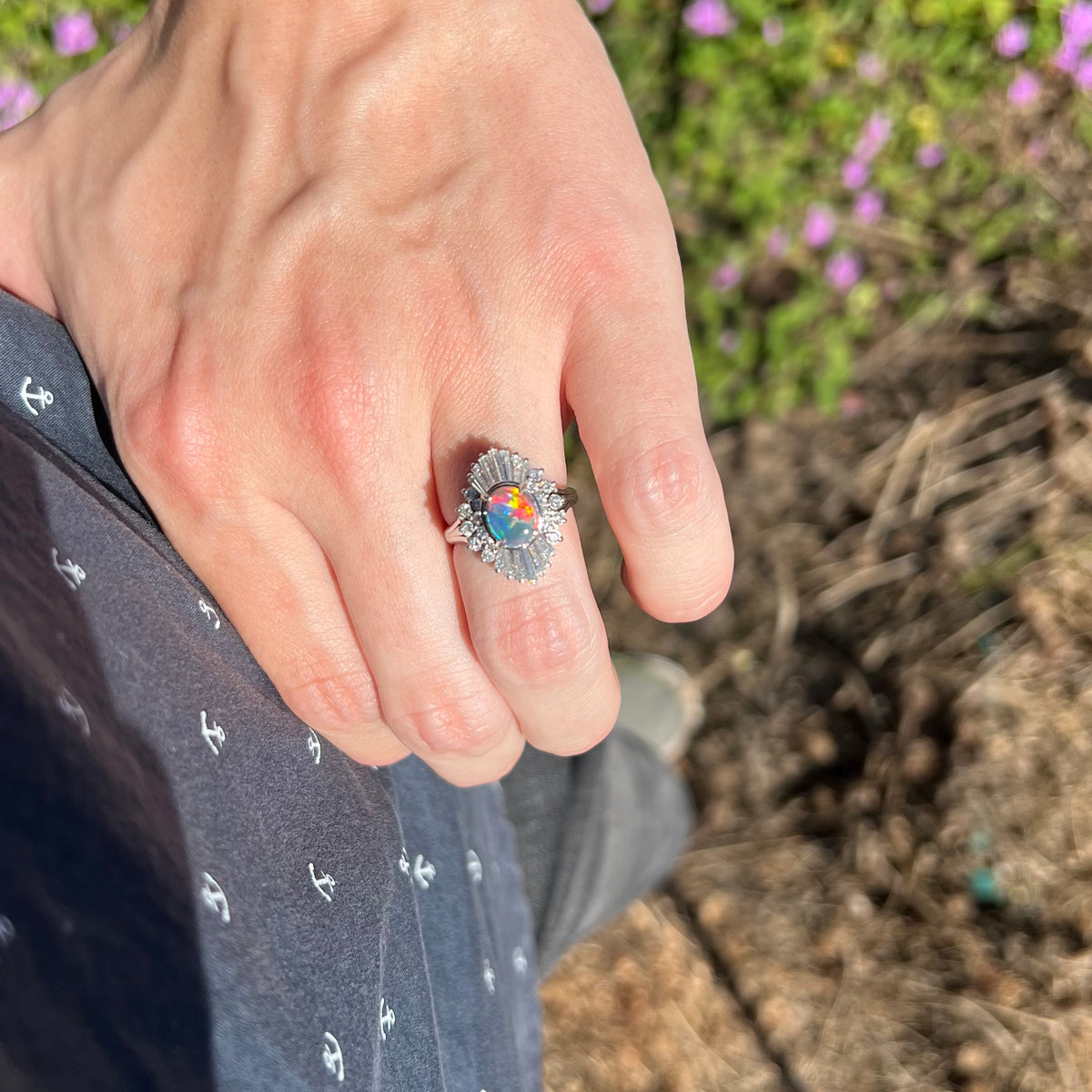
Duality is a late-Shōwa Japanese Pt900 platinum ballerina ring centered by a 0.96-carat natural Australian black opal and framed by 1.21 carats of natural diamonds. The center stone is modest in physical scale, measuring approximately 7.73 × 6.40mm, but unusually rich in character: a naturally occurring band of black potch divides its play-of-color into two directional sections, allowing one half to ignite as the other quiets before both occasionally come alive together. Around it, thirty-two diamonds repeat the same visual contrast, with sharp tapered baguette fans at the north and south softened by round brilliant-cut diamonds along the east and west sides.
Approximate current ring size: 5.75 US. Please contact us regarding resizing.
Two Personalities Within One Black Opal
Duality is best understood through movement rather than a single photograph. Its N4 body tone supports genuine multicolor play-of-color dominated by warm red and orange, accompanied by yellow, green, blue, and occasional purple. The exact balance changes substantially with the light source, viewing angle, and orientation of the ring.


Direct sunlight and other strong single-source lighting make its divided nature most apparent. Each diagonal section tends to activate independently: just as one half begins to quiet, the other can flare into red and orange with yellow overtones, accented by blue, green, and minute purple. Neither side is permanently associated with one set of colors. Both are capable of producing essentially the same broad spectrum; what changes is which portion of the opal catches the light most strongly at a given moment.
Under softer or more diffused illumination, the relationship changes. Shade, filtered daylight, cloudy conditions, and rooms where multiple light sources reach the stone can allow both sections to play more readily at the same time. Orange becomes especially prominent under ordinary indoor lighting, often accompanied by iridescent green overtones and subtler blue beneath. Cooler white lighting can shift the balance again, strengthening red, blue, and purple.

Even when its brightest flashes are not fully activated, the opal rarely becomes visually inert. In subdued environments, its colors take on an unusual metallic or pearlescent character, with red and orange remaining visible against the dark body tone. This ability to remain interesting outside a single privileged angle separates Duality from many strongly directional opals whose color can disappear almost completely when turned away from their best orientation.
When active, individual areas of color can become exceptionally bright. We conservatively grade the opal’s overall brightness at approximately B3.5 of 5 because of its highly directional behavior, although its strongest flashes can appear considerably brighter. For someone accustomed to judging opal by a single photograph or fixed viewing angle, Duality is a particularly poor candidate for reduction to one image.
A Ballerina Setting Built Around Contrast
The setting repeats the same contrast found within the opal itself.
Fourteen carefully graduated tapered baguette diamonds extend outward in dramatic fan-like arrangements above and below the center stone, creating the sharp linear architecture associated with the ballerina tradition. Along the sides, eighteen round brilliant-cut diamonds soften that geometry with smaller points of white sparkle and a more romantic outline.
Together, the thirty-two natural diamonds total 1.21 carats, a weight recorded inside the ring. We estimate the round diamonds at approximately 0.34 carat total, averaging around SI2 clarity and G-H-I color, while the tapered baguettes account for approximately 0.87 carat and average around VS2 clarity with slightly warmer H-I-J color. The difference in body color between the two cuts is subtle and most likely to be noticed only by a particularly color-sensitive viewer.
What is remarkable is how much diamond weight the ring carries without becoming visually heavy. At 1.21 carats, the diamonds outweigh the 0.96-carat center opal, yet their long, narrow proportions create reach rather than bulk. The theatrical baguettes enlarge the ring’s presence while the smaller round diamonds soften its outline, allowing Duality to feel extravagant in detail while remaining surprisingly graceful on the hand.
That balance is particularly apparent on smaller fingers. Duality does not wear like a conventional oversized cocktail ring. Its approximately 18.70mm top has substantial presence, but the narrow baguettes, open spaces, and relatively compact center stone keep the design from overwhelming the wearer. It is an unusually convincing choice for someone drawn to important jewelry who ordinarily prefers more refined proportions.

Beneath the diamonds, the late-Shōwa workmanship becomes more intimate. Open platinum filigree curls through the gallery, largely hidden while the ring is worn, while the shoulders divide into three angular sections before resolving into the solid shank. The result is characteristic of the finest details in vintage Japanese jewelry: the visible spectacle receives the attention first, but workmanship continues into areas intended primarily for the wearer.
Natural Structure, Hallmarks, & Condition
The feature responsible for Duality’s optical division is part of the opal’s natural formation.
Along exposed edges of the cabochon, naturally occurring white potch reaches the surface in several irregular, lightly pitted areas. On other edges, a darker layer of black potch rises unevenly through the stone. At its highest point, a narrow branch of this black potch continues visibly through the face of the opal, creating the sharp internal line that separates its two directional sections.
Despite its appearance, this feature is not a crack or fissure. It is naturally occurring black potch, opal material without play-of-color, incorporated into the stone during formation. Together with the surrounding dark structure, it contributes both to Duality’s N4 body tone and to the unusual optical behavior for which the ring is named.
Under magnification, we observe light surface scratches and abrasions consistent with vintage wear, but no evidence of crazing or structural cracking. The opal's internal structure is naturally complex, with black potch and sharply defined color-bar boundaries that can appear fracture-like from certain angles. The stone retains a strong overall polish and remains securely held in its elevated prong setting.
The ring itself has been professionally cleaned and the platinum polished by OpalPop’s jeweler in Anaheim, California. It now presents in excellent vintage condition.


Inside the shank are the marks “Pt900,” “1 21,” and “096.” These record the solid .900 platinum construction, the stated 1.21-carat total diamond weight, and the stated 0.96-carat opal weight. No maker’s mark is present.
Duality is attributed to approximately the 1980s during Japan’s late-Shōwa era. Its earlier route from Japan to the United States is undocumented; OpalPop acquired the ring from the collection of a diamond-specialty jewelry boutique in Woodbine, Iowa. The opal is Australian and is attributed, though undocumented, to Lightning Ridge based on its visual characteristics.
Wearing & Caring for Duality
Duality has a substantial high-profile construction, rising approximately 10.91mm from the finger. Its elevated prong setting intentionally leaves much of the opal’s edge visible, helping the center stone remain visually distinct from the surrounding diamonds but also leaving it more exposed to accidental impact.
For that reason, we recommend mindful, occasional wear rather than treating Duality as a no-precautions everyday ring. It should be removed for exercise, housework, gardening, lifting, or other activities where the opal could be struck.
That consideration is particularly important for someone choosing Duality as an unconventional black opal engagement ring. Its combination of natural black opal, substantial diamonds, vintage Japanese platinum, and refined proportions makes it a compelling alternative to conventional bridal jewelry, but opal requires a more deliberate relationship with everyday wear than diamond, sapphire, or other harder center stones.
For someone searching for an exceptional gift, Duality offers an unusual balance. It has enough diamonds and visual drama to feel unmistakably special, yet its proportions remain refined enough for a woman who may not ordinarily gravitate toward large or overtly flashy jewelry. The opal provides the rarity and individuality; the Japanese setting supplies workmanship, substance, and nearly as much fascination beneath the ring as above it.
Whether given as a meaningful anniversary or birthday gift, chosen as an unconventional engagement ring, or selected for oneself, Duality is ultimately about contrast: warm color against a dark body, one directional half against the other, sharp baguettes against soft round diamonds, and theatrical detail contained within a ring that remains unexpectedly graceful on the hand.
More Information
The Center Stone: Natural Black Opal, solid
- carat weight: 0.96ct (inscribed in ring's shank)
- country of origin: Australia
- attributed mining locale: Lightning Ridge
- brightness of color play: B3.5 of 5
- body tone: N4
- shape: oval cabochon cut
- stone measurements (millimeters): 7.73mm x 6.40mm
- stone measurements (inches): 0.3" x 0.25"
- play of color description: predominantly orange with red/yellow/blue overtones and green undertones
- additional notes: highly-directional play-of-color between two naturally-regimented, distinct sections
The Accent Stones: Diamond, natural
- stone count: 32
- 18 rounds
- 14 baguettes
- total carat weight: 1.21cts (inscribed in ring's shank)
- approx. 0.34ct rounds
- approx. 0.87ct baguettes
- cut: Standard Round Brilliant Cuts; tapered baguettes
- average clarity grade:
- rounds: SI2
- baguettes: VS2
- average color grade:
- rounds: G-H-I
- baguettes: H-I-J
The Setting: Japanese Shōwa Ballerina Ring
- metal: .900 platinum, solid
- top of ring width: 18.70mm (0.75")
- ring height from finger: 10.91mm (0.4")
- bottom of shank width: 2.43mm
- ring weight: 7.79 grams
- approximate current ring size: 5.75 US


OpalPop Customer Reviews
Still searching? We've got even more opal jewelry below...
-
Hanabi | 2.58ct Multicolor Australian Black Opal & Diamond Ballerina Ring in Platinum, c.1980s
Regular price $22,800.00 USDRegular priceUnit price per -
The Empress | Vintage Japanese 11.46ct Rectangular Australian Light Opal & Diamond Cocktail Ring in Platinum, c.1950s
Regular price $16,800.00 USDRegular priceUnit price per -
Jericho | Men's Australian Boulder Opal Ring in Sterling Silver with 21k Gold Nuggets
Regular price $1,480.00 USDRegular priceUnit price per -
Heart of Atlantis | Vintage Modernist Green-Blue Australian Boulder Opal & Diamond Pendant in 18k Gold
Regular price $9,800.00 USDRegular priceUnit price per -
Cortney | Natural Coober Pedy White Opal Tennis Bracelet in 10k Gold, 7.5 Inches
Regular price $1,680.00 USDRegular priceUnit price per -
Fern & Pine | Australian Dark Opal Seam Dangle Earrings in 14k Gold
Regular price $2,480.00 USDRegular priceUnit price per -
Abby | Multi-Stone Mexican Fire Opal Necklace in Sterling Silver
Regular price $125.00 USDRegular priceUnit price per -
Abigail | Handmade Opal Doublet Ring in Sterling Silver by Hailey Johnson, c.2010s
Regular price $285.00 USDRegular priceUnit price per -
Ahava | Israeli Designer Opal, Garnet, & Amethyst Heart Necklace in Sterling Silver
Regular price $325.00 USDRegular priceUnit price per -
Alina | 1.88ct Lightning Ridge Black Opal & Diamond Ring in Platinum
Regular price $2,880.00 USDRegular priceUnit price per -
Alstromeria | Fire Opal & Diamond Flower Ring in Sterling Silver
Regular price $225.00 USDRegular priceUnit price per -
Alvara | Three-Stone Ethiopian Opal Ring in Black Rhodium-Plated Sterling Silver
Regular price $145.00 USDRegular priceUnit price per