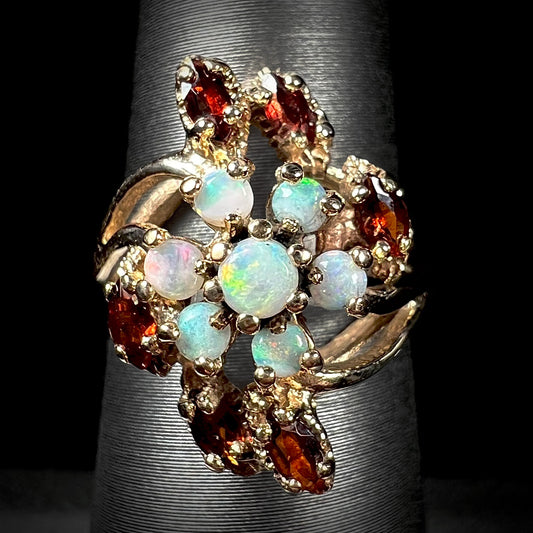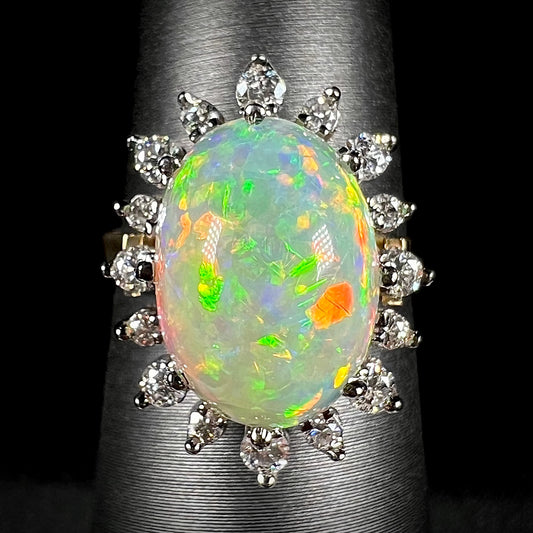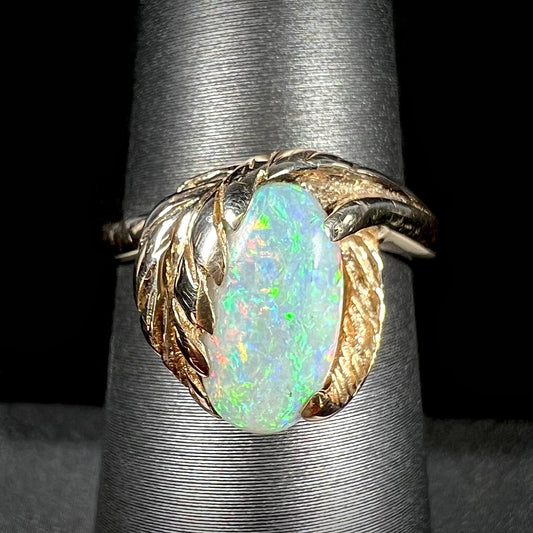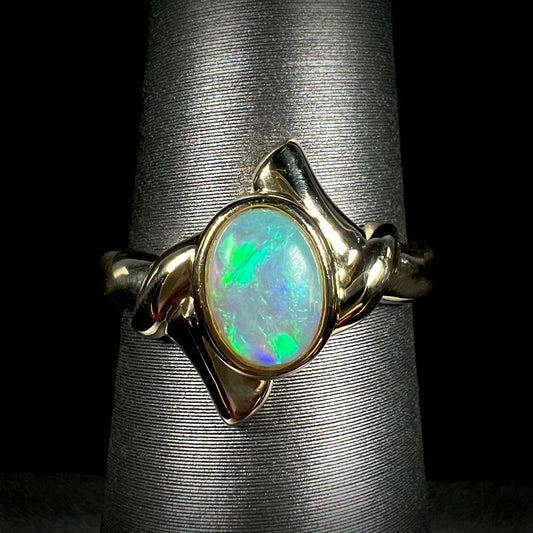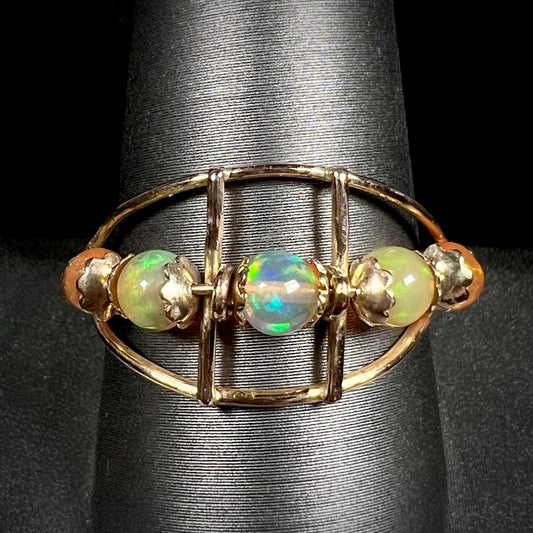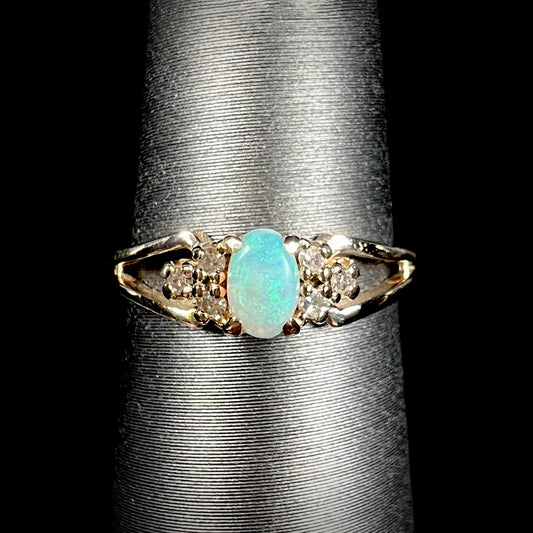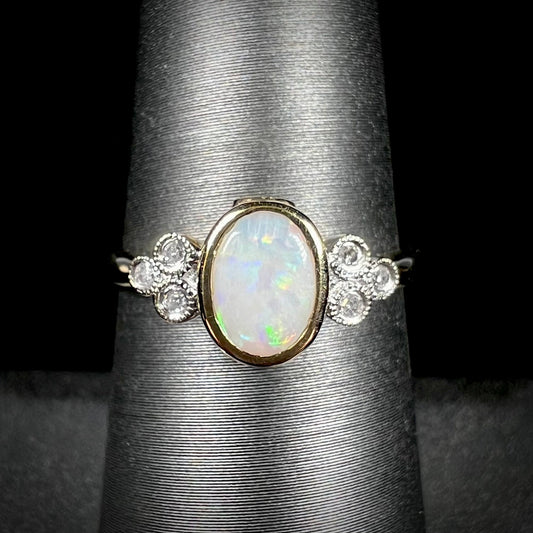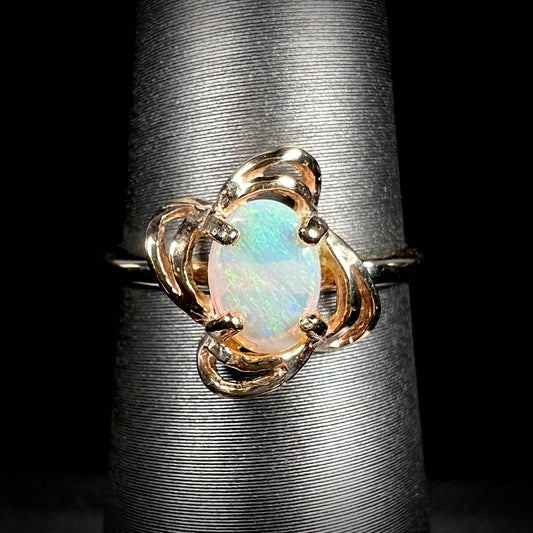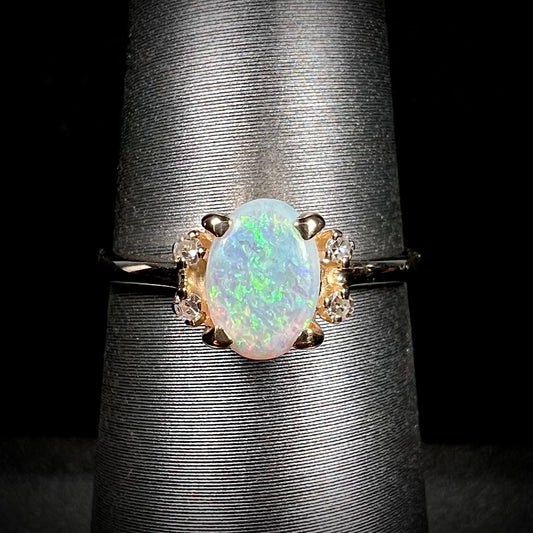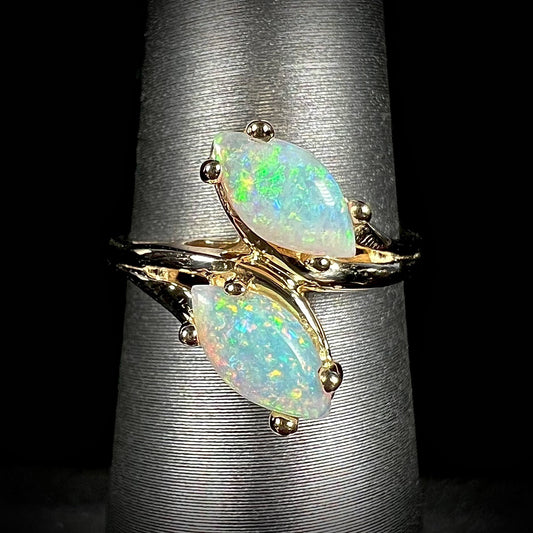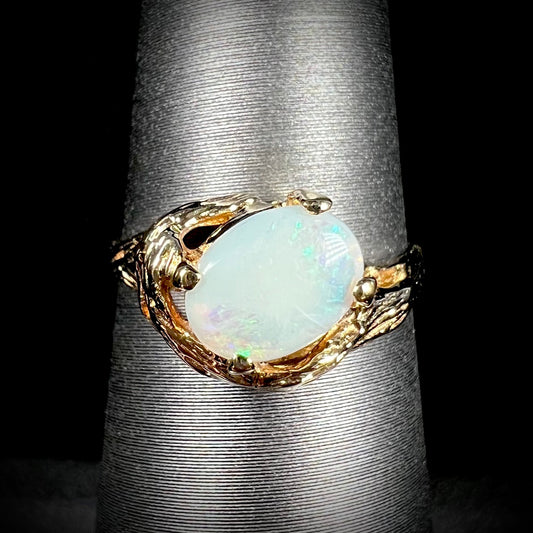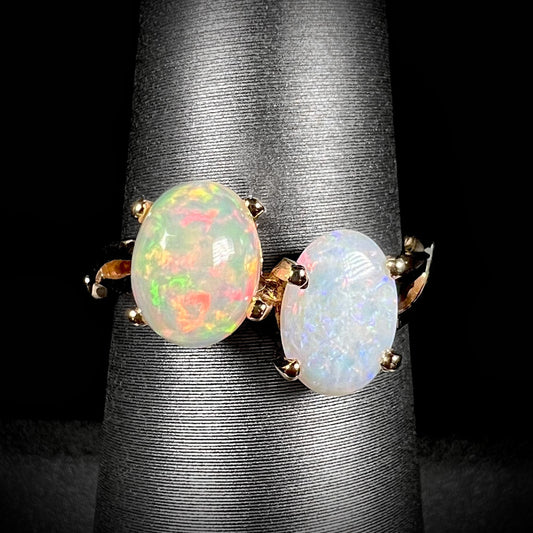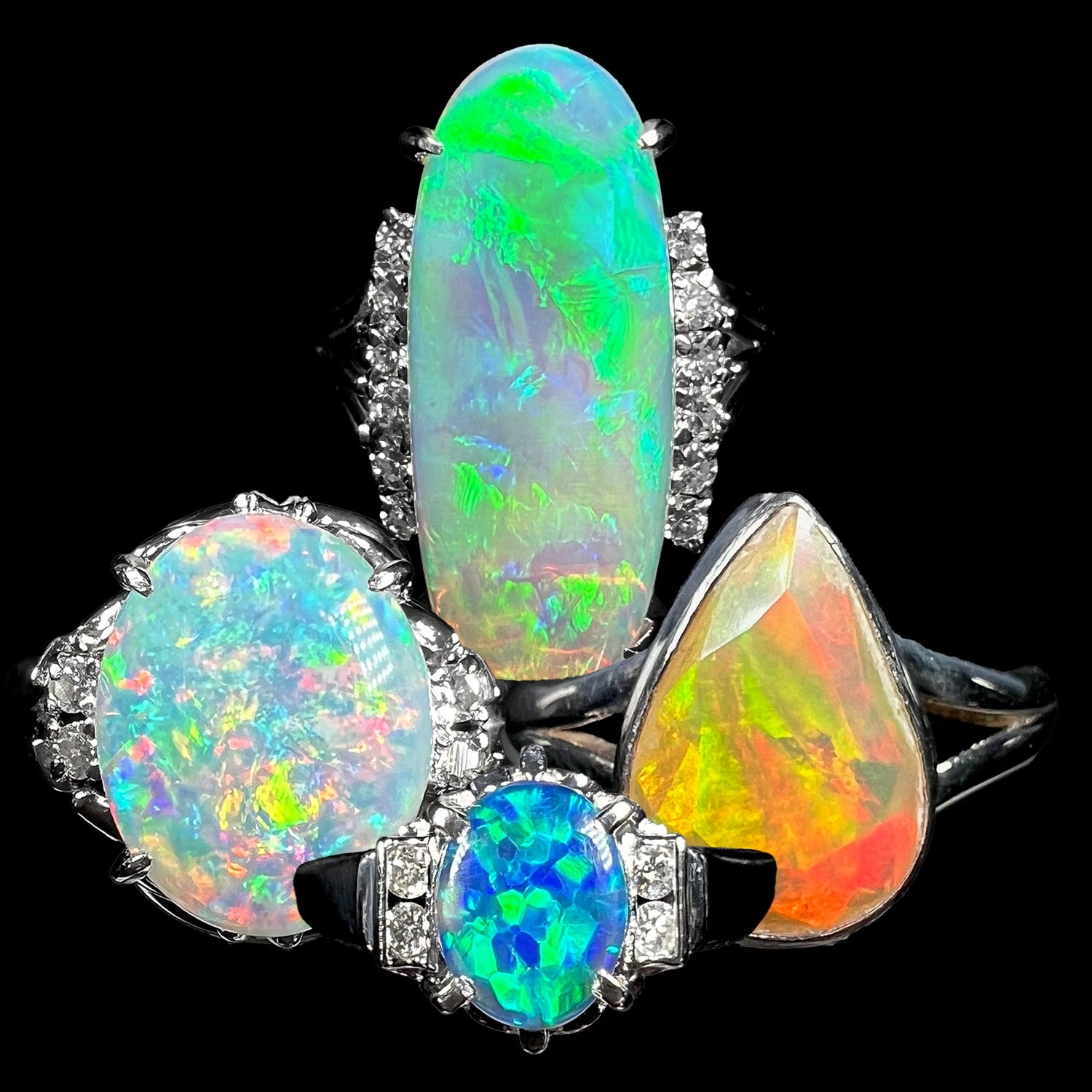
Collection: Yellow Gold Opal Rings

Gold, As It Has Always Been.

Yellow gold has long defined the traditional form of rings—its color familiar, its presence constant, and its meaning shaped by the person who wears it.


Yellow Gold Opal Rings: A Deeper Look

OpalPop’s collection of yellow gold opal rings spans a range of karat purities, eras, and design styles.  Because gold color trends have shifted over time in the United States, yellow gold is often tied to specific periods—most notably the Mid-Century designs of the 1950s–1960s, the Brutalist styles of the 1970s, and the Modernist pieces of the 1980s.  As a result, vintage opal rings from these eras make a strong presence here, sitting alongside modern custom creations.

Yellow gold–plated and gold-filled rings are intentionally excluded, allowing those seeking solid gold options to browse without distraction.  Occasionally, sterling silver or white gold rings incorporating solid yellow gold elements may also appear.

In our broader Gold Opal Rings guide, we explore gold as a system of choices—spanning color, purity, and construction.  In the Yellow Gold Opal Jewelry guide, we focus more specifically on yellow gold’s cultural role, visual identity, and how karat purity affects its color.

Here, the lens narrows further.  Rings carry a level of personal meaning that other jewelry types rarely match, while also experiencing the most consistent wear.  The sections below focus on how yellow gold interacts with different opal varieties, how it performs over time on the hand, and what to consider when selecting a ring—particularly for engagement.

How Yellow Gold Interacts with Different Opal Varieties

Color interaction plays a defining role in how an opal is perceived—both in its body tone and its play-of-color.  What is often overlooked is how strongly the metal surrounding the stone influences that perception.

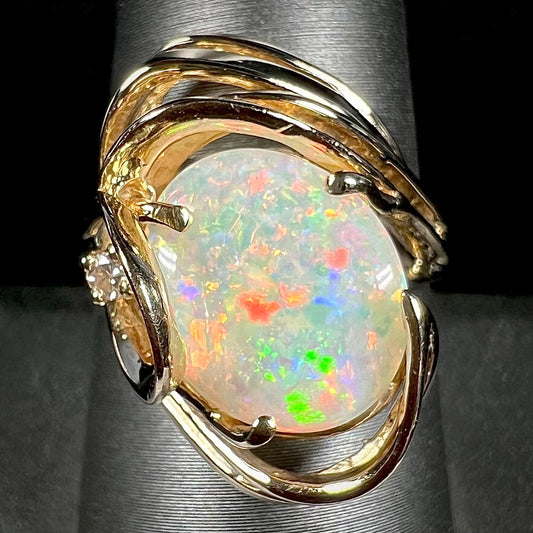
Because rings are seen constantly by the wearer, the pairing of opal and metal becomes part of a daily visual experience.  In general, the warmth of yellow gold tends to enhance warmer flashes within an opal—particularly red, orange, yellow, and pink—helping the eye register even subtle colors more easily.

White Opals in Yellow Gold

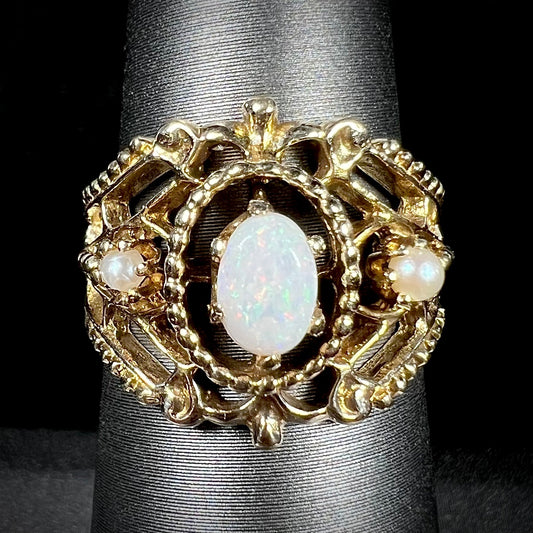
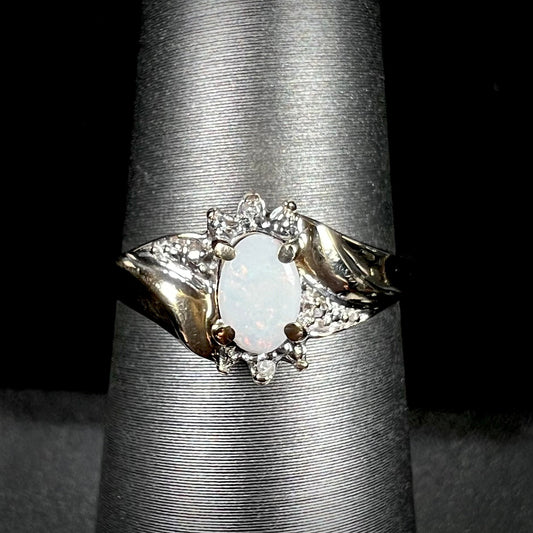
White opals set in yellow gold represent one of the most traditional combinations in opal jewelry.  Whether in true vintage Mid-Century pieces or modern minimalist settings, this pairing reflects a long-established aesthetic.

Due to the widespread availability of Australian white opals throughout the 20th century—and yellow gold’s dominance from the 1940s through the 1980s—this combination carries a strong heirloom character, often associated with inherited or generational jewelry.

Black Opals in Yellow Gold

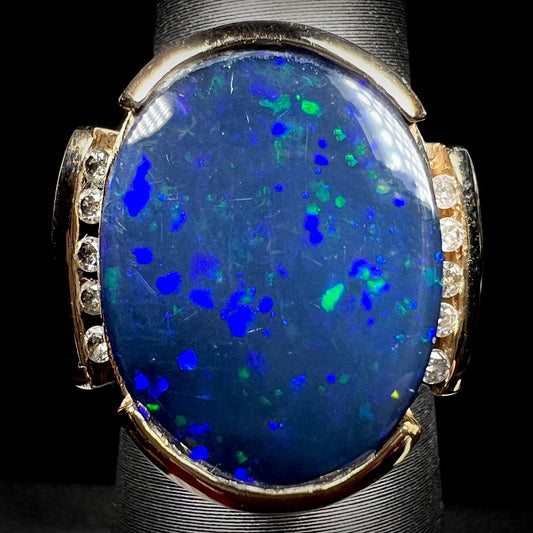
When set in yellow gold, black opal rings take on a distinct sense of presence.  The contrast between dark body tone and warm metal creates a visually striking result that reads as deliberate and elevated.

Black and dark opals have remained rare across all time periods.  When paired with yellow gold, the result is often perceived as unmistakably significant—even by those who may not fully understand the material itself.

Fire Opals in Yellow Gold

From a color theory perspective, few combinations are more naturally aligned.  Fire opals—particularly those with orange, red, or yellow body tones—pair seamlessly with yellow gold.

Because many fire opals have transparent bodies, the warmth of the setting can reflect through the stone itself, subtly intensifying warm body tones and flashes of color.  The result is a visually cohesive pairing that feels unified rather than contrasted.

Crystal Opals in Yellow Gold

At OpalPop, “crystal opal” is often used broadly to describe transparent material, including fire opal.  Here, the term is used more strictly—referring to colorless or near-colorless opals with a glassy, transparent body.

In these stones, much of the visual appeal comes from the way light moves within the material itself.  When set in yellow gold, the metal introduces a warm influence that can shift how the stone is perceived.

While this can give the piece a stronger sense of presence, it may also introduce a subtle yellow cast to otherwise neutral material—something more selective buyers may prefer to consider.

Boulder Opals in Yellow Gold

Boulder opals, particularly those with visible ironstone matrix, often carry a more rugged, natural aesthetic.

Yellow gold complements the earthy tones of the ironstone while also elevating the perceived importance of the stone itself.  For viewers unfamiliar with boulder opals, the presence of yellow gold can provide context—visually reinforcing that the piece carries value beyond its unconventional appearance.

Wear and Care of Yellow Gold Opal Rings

A simple rule applies: treat an opal ring as though it were set with glass.

To reduce risk, remove rings during manual activity and consider bezel settings, which protect the edges of the stone more fully than prongs.

In terms of metal behavior, yellow gold offers advantages distinct from white gold.  While white gold is harder and more scratch-resistant, it is also more brittle.  Yellow gold, by contrast, is more malleable—allowing it to absorb impact more effectively.

This difference becomes important in real-world wear.  Under sudden force, white gold is more prone to cracking, while yellow gold is more likely to bend.  Neither outcome is ideal, but bending is generally more recoverable than breakage.

The same principle applies to prongs.  Yellow gold prongs may wear more quickly over time, but they are less likely to snap completely from a single impact.  This reduces the risk of immediate stone loss—an important consideration given the relative fragility of opals themselves.

Malleability also affects how rings are made.  Yellow gold allows for more intricate, hand-worked designs, while white gold is typically more limited to cast construction due to its structural properties.

Durability Differences Across Yellow Gold Karat Purities

Karat purity affects how yellow gold performs on the hand.

Higher karat gold is softer.  Lower karat gold is harder.  In most cases, “harder” translates to greater resistance to wear—but alloy composition still plays a role.

10k Yellow Gold

The hardest standard purity in the United States, 10k yellow gold rings offer strong resistance to scratching and deformation.

With lower gold content, these alloys are more rigid but can also be more brittle.  While uncommon, if cracking were to occur in yellow gold, it is most likely to happen in lower-karat alloys.

10k gold also places some limitations on fabrication.  Depending on the specific alloy, it may be less suitable for highly intricate hand-work compared to higher purities.  Similar behavior can be observed in English 9k yellow gold rings.

14k Yellow Gold

Widely considered the American standard, 14k yellow gold rings strike a balance between durability and workability.

While slightly softer than 10k, 14k remains well-suited for everyday wear while offering improved malleability.  This makes it a preferred material for both durability and design flexibility.

18k Yellow Gold

18k yellow gold rings emphasize color, weight, and material presence.  With 75% pure gold, they appear richer in tone and feel more substantial on the hand.

That same purity also makes them softer and more susceptible to surface wear.  For this reason, 18k is best suited to wearers who are mindful of when and how their rings are worn.

A Note on Mixing Karat Purities

Karat differences are not only structural—they are visual.

Higher-karat gold displays a deeper, more saturated yellow tone, while lower-karat alloys appear lighter.  When worn together on the same hand, these differences can create subtle—but noticeable—variation in color.

For many, this contrast is negligible.  For others, it is something worth considering, particularly when combining 18k with lower purities.

Sizing and Solder Seams in Yellow Gold

Ring sizing involves cutting and rejoining the shank using solder.  While jewelers work to match color as closely as possible, exact alloy matching is not always achievable.

As a result, faint seams may sometimes be visible at the base of a resized yellow gold ring.  Unlike white gold, which is often rhodium plated to create a uniform surface, yellow gold reveals these details more openly.

This is most commonly observed in vintage rings.  At OpalPop, such features are considered part of a piece’s history rather than a flaw.

Yellow Gold Opal Engagement Rings

As noted earlier, opals require care.  Bezel settings offer the greatest protection, and daily wear should be approached thoughtfully.

For those intending to wear an opal engagement ring regularly, durability should guide design choices.  For occasional wear, greater flexibility is possible.

When selecting yellow gold specifically, the most important factor is preference.  Gold color is highly personal, and it has a direct impact on long-term satisfaction.

Where possible, it is best to confirm this preference directly or observe what the recipient already wears.  For those choosing without certainty, yellow gold is most often favored by individuals drawn to traditional design and established aesthetics.

Dig Deeper

Explore more curated collections similar to Yellow Gold Opal Rings: