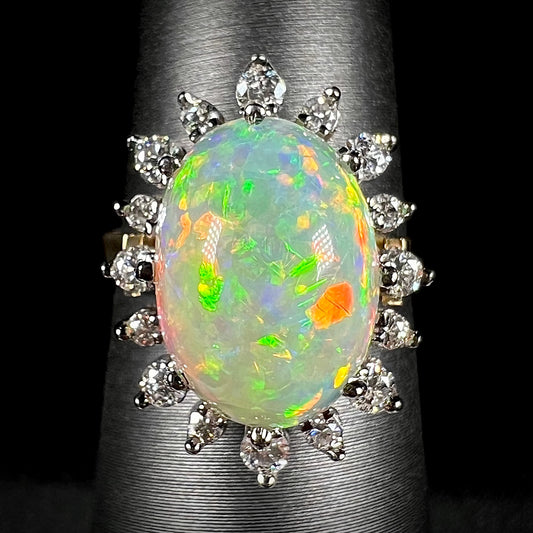
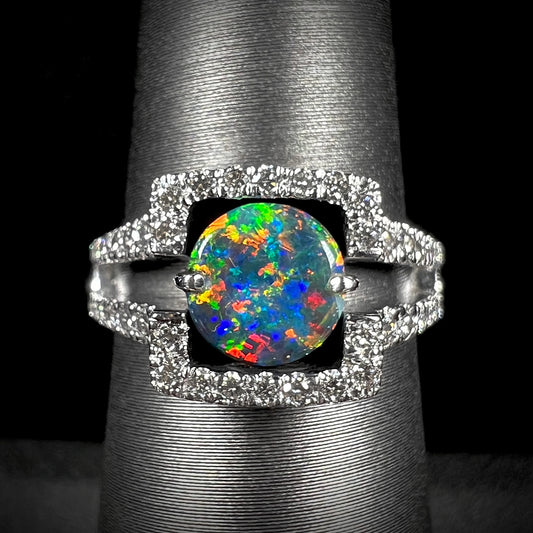
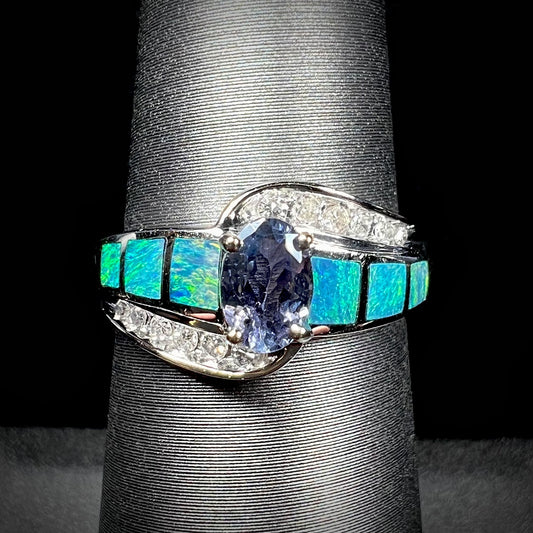
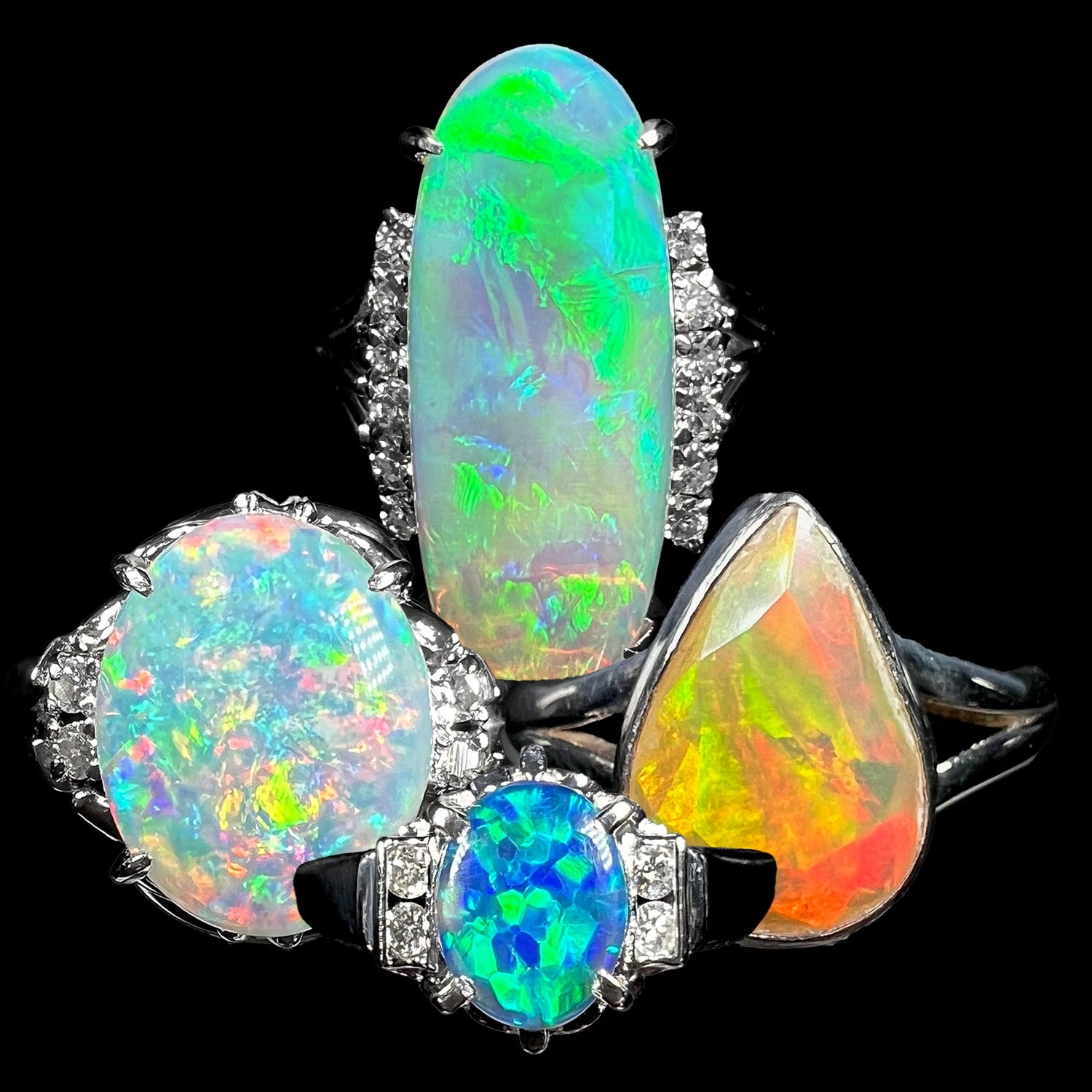
OpalPop’s collection of white gold opal rings includes American artist-made designs, vintage international finds, and commercially manufactured pieces crafted across a range of karat purities. Occasionally, rings that are primarily yellow gold but incorporate meaningful white gold elements are also included.
In our broader Gold Opal Rings guide, we explain that “gold” is not a single option, but a network of choices. In our White Gold Opal Jewelry guide, we focus on white gold more broadly—its history, rise in popularity, and the fundamentals of rhodium plating.
Here, the focus narrows to white gold opal rings specifically: how different opal varieties interact with white gold on the hand, what durability factors matter in daily wear, how rhodium plating behaves over time, and key considerations for engagement ring buyers.
Nickel Sensitivities and White Gold Rings
Before anything else, prospective buyers should consider whether they have a nickel sensitivity.
Most white gold rings sold in the United States are alloyed with nickel and zinc to achieve their color. For some wearers, this can lead to skin irritation, including itching or rashes—particularly with rings, where prolonged skin contact is unavoidable.
If you have worn white gold rings before without issue, this is typically not a concern. For first-time buyers, a professional allergy test conducted by a dermatologist is the most reliable way to confirm compatibility.
For those willing to test informally, wearing a borrowed white gold ring for several days or placing a U.S. nickel coin against the skin, held in place for a prolonged period by tape can provide an indication. Any irritation should be taken as a sign to avoid nickel-based alloys.
If sensitivity is a concern, platinum rings offer a hypoallergenic and visually similar alternative.
How White Gold Interacts with Different Opal Varieties
Metal color plays a direct role in how an opal is perceived—particularly in rings, where the stone is seen constantly by the wearer.
White gold acts as a neutral base. Unlike yellow gold, which can introduce warmth, white gold allows an opal’s natural color to present with minimal influence. Cooler tones—such as blue, green, and violet—often appear more defined in this setting.
White Opals in White Gold
White opals set in white gold create a clean, understated aesthetic. The combination feels quiet and modern, with little visual interference from the metal.
In Vedic astrology, white opals set in white metals—such as white gold, silver, or platinum—are associated with Venus. When worn as rings on the middle or ring finger of the dominant hand, this pairing is believed to be powerful in promoting love, creativity, and material harmony.
Black Opals in White Gold
Black opals and dark opals in white gold produce strong contrast without excess visual weight. The neutral metal allows darker body tones to appear deeper, emphasizing one of the stone’s most valued characteristics.
Finer examples are often set in designer-crafted 14k white gold and 18k white gold mountings.
Fire Opals in White Gold
Fire opals paired with white gold create a high-contrast “fire-on-ice” effect. Warm body tones stand out sharply against the cool metal, making this one of the most visually striking combinations.
This aesthetic saw particular popularity in Japan during the latter half of the 20th century. Modern examples often feature Ethiopian material, commonly set in purities ranging from 10k white gold to 18k white gold.
Crystal and Semi-Crystal Opals in White Gold
At OpalPop, “crystal opal” is often used broadly to describe any transparent material. In the stricter trade sense, it refers specifically to Australian crystal opals that are typically colorless or near-colorless.
These stones pair especially well with white gold. Their clarity and body tone remain visually unchanged, allowing their internal color play to stand on its own without influence from the setting.
Boulder Opals in White Gold
Boulder opals often present a rugged, unconventional appearance due to visible ironstone matrix inclusions.
In white gold, this can create a modern, minimal aesthetic—but without the visual context that yellow gold provides. To unfamiliar viewers, these pieces are often mistaken for silver, even when the stone itself is highly valuable.
Practicality and Durability of White Gold Opal Rings
General Opal Ring Guidance
Opals should be treated with the same care as glass.
Rings are best worn occasionally and removed during manual activity. Bezel settings—where the stone is fully surrounded by metal—offer significantly more protection than prong settings, which leave edges exposed.
What to Expect from White Gold
White gold is harder than yellow gold due to its alloy composition. This increases scratch resistance and allows prongs to retain their shape for longer periods between servicing.
However, that hardness comes with a trade-off: brittleness.
Under impact, white gold is more likely to crack than bend. While this is not common in well-made pieces, it becomes a consideration in areas exposed to stress—particularly prongs and the base of the shank.
Alloy quality plays a role here. White gold is more temperamental than yellow gold when recycled, and improper handling during manufacturing can introduce porosity—clusters of small structural pits that weaken the metal and make it difficult to polish. This is a production issue, not something that develops over time.
When properly made, white gold rings remain stable and wearable for decades.
From a styling standpoint, white gold is highly versatile. Its neutral tone allows it to blend seamlessly with other white metals such as platinum, sterling silver, and stainless steel.
Rhodium Plating and Maintenance
White gold’s bright white appearance comes from rhodium plating.
In its natural state, white gold has a faint yellowish tint—more noticeable in higher karat purities. Rhodium, a hard platinum-group metal, is applied as a surface layer to create a uniform white finish while also improving scratch resistance.
On rings, this plating wears over time—particularly at high-contact areas such as the sides and bottom of the shank. As it wears, the underlying tone of the gold may begin to show through.
Most wearers do not immediately notice this change, but those who prefer a bright-white finish can have the ring replated. For regularly worn rings, this is often done on a yearly basis, though wear patterns and skin chemistry can affect timing.
Rhodium plating can also conceal minor manufacturing imperfections. In cases where structural flaws such as porosity exist, they may become visible only after the plating wears.
The Printer Paper Test for Rhodium Wear
A simple at-home method is to view the ring against white printer paper under neutral lighting. Any visible yellowing—especially along the shank—indicates that the rhodium layer has worn.
At that point, the choice is aesthetic: restore the original finish or leave the ring as-is.
White Gold Opal Engagement Ring Considerations
White gold can be a practical and durable choice for an opal engagement ring—but two factors should be confirmed in advance.
First, metal preference. Gold color is highly personal and can significantly affect long-term satisfaction.
Second, nickel sensitivity. Rings maintain constant skin contact, making compatibility especially important.
Rhodium maintenance is often perceived as a drawback, but in practice, many wearers do not notice gradual changes in finish.
As always, the core principle remains: opals should be worn with care. Lower-profile designs and protective bezel settings are strongly recommended over high-set prong mountings.