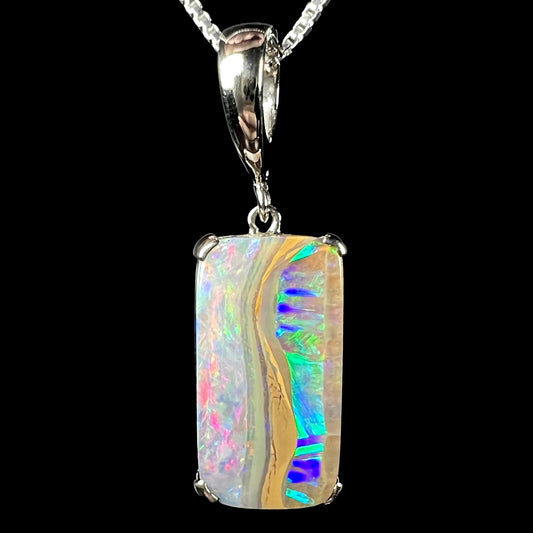
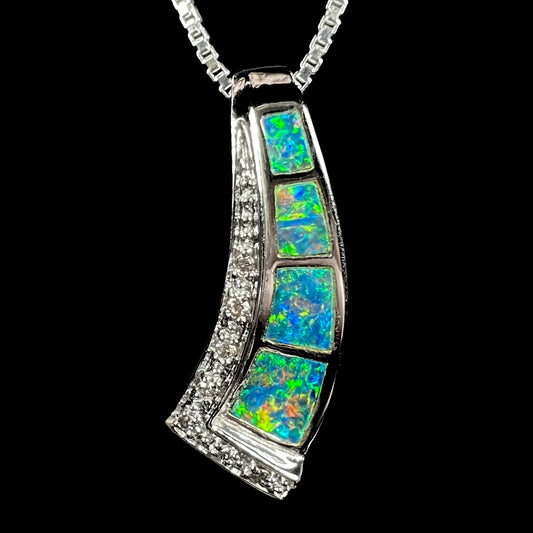
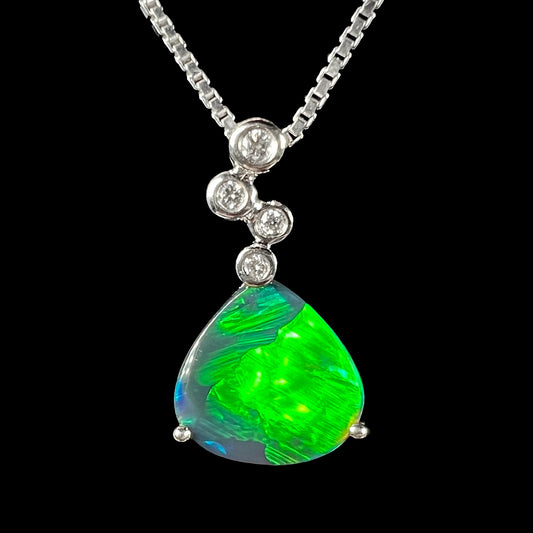
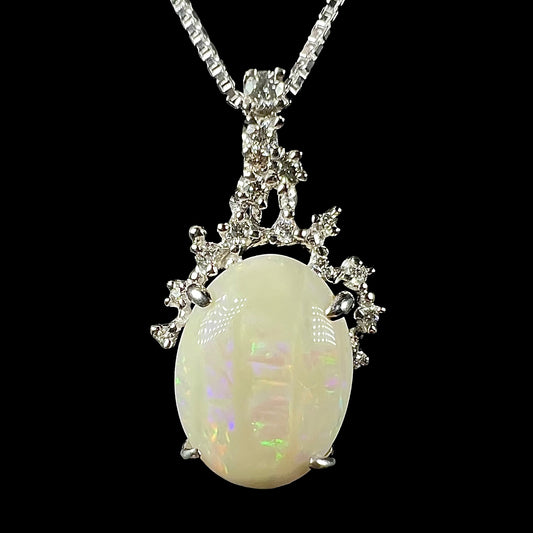
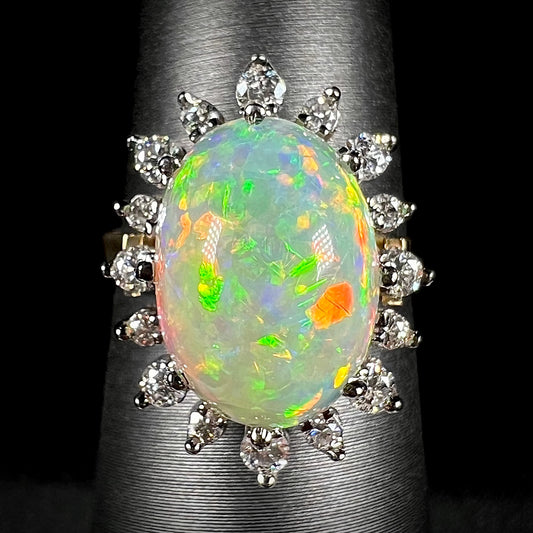
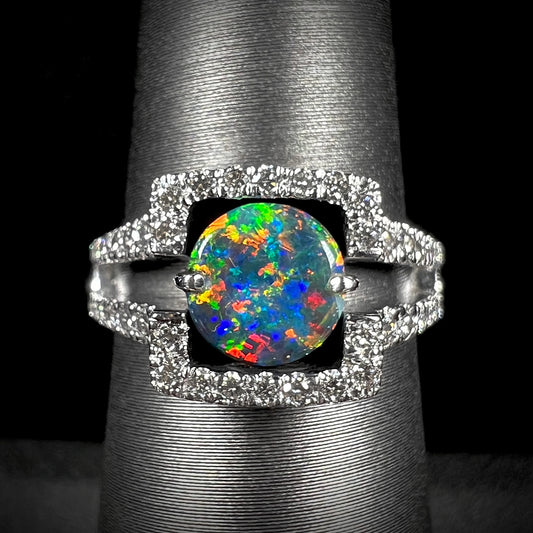
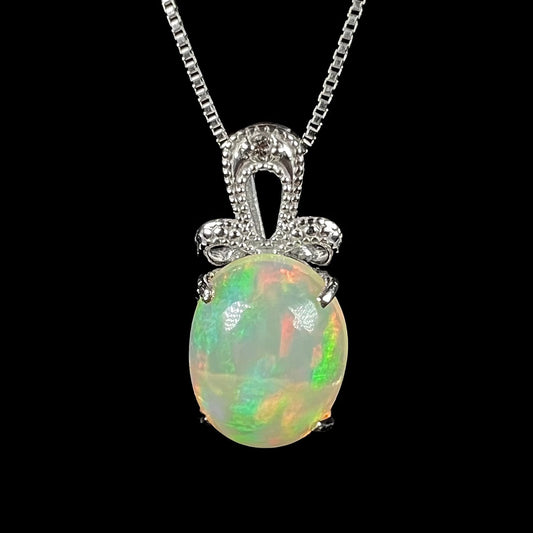
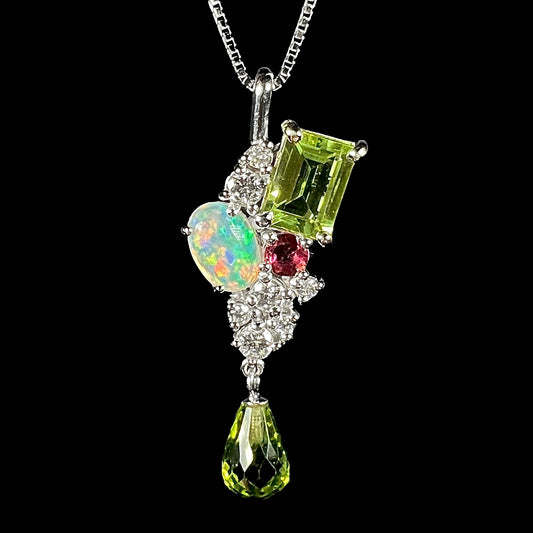
OpalPop’s selection of white gold opal jewelry includes rings, necklaces, and occasional pairs of earrings crafted from solid white gold across a range of karat purities. Pieces are sourced globally, from independent American artists to vintage Japanese estates.
In our broader Gold Opal Jewelry guide, we explain that “gold” is not a single material, but a system of choices defined by color, purity, and context. Here, the focus narrows to white gold—its relatively recent history, how it is perceived, the role of rhodium plating, and a few practical considerations before purchase.
The History of White Gold: A Platinum Alternative
Compared to yellow gold’s thousands of years of use, white gold is a modern development. It does not occur naturally in its final form. Instead, it is created by alloying yellow gold with white metals to produce a cooler, silvery appearance while still meeting the purity standards required for 10k, 14k, or 18k gold.
While experimental alloys existed as early as the 18th and 19th centuries, white gold did not enter widespread commercial use until the early 20th century. Its rise was driven by a specific need: a more accessible alternative to platinum jewelry.
During the 1910s and 1920s, demand for white metal jewelry surged alongside the Art Deco movement, which favored sharp contrast and monochromatic design. At the same time, platinum became increasingly scarce and expensive due to its importance in World War I military manufacturing. In response, jewelers and metallurgists across the United States and Europe developed new alloy formulas, leading to a wave of patents for white gold compositions.
The price gap between platinum and gold was significant—but the practical difference was even greater than it appeared on paper. Around 1920, platinum traded between $120 and $145 per ounce, while pure gold sat near $20. However, standard 14k gold is only 58.5% pure, while platinum jewelry is typically 90–95% pure and significantly denser.
When accounting for both purity and weight, the comparison shifts dramatically. A piece made in platinum requires roughly 40% more material than its equivalent in 14k white gold, bringing the effective cost difference closer to $11.70 versus $168.00 when compared in finished jewelry form.
White gold was not simply a cheaper metal—it was a practical solution that allowed the jewelry industry to continue producing white-toned designs during periods when platinum was legally restricted to the public or prohibitively expensive.
White Gold Opal Jewelry Trends Over Time
In Western markets, jewelry trends move in cycles—and white gold has followed a pattern of repeated resurgence.
After its introduction in the early 20th century and widespread adoption during the Art Deco era, white gold saw renewed use following World War II. Platinum was again restricted for military purposes, and white gold re-emerged as the industry’s primary white metal.
Over time, its role shifted from substitute to standard. By the 1990s, white gold had become the dominant choice in the United States, particularly in engagement jewelry, where its neutral tone presented diamonds cleanly and without color interference. That dominance has continued through the 2020s.
In parallel markets such as Japan, similar preferences emerged, reinforcing white gold’s association with modern, understated design.
Rising gold prices have further shaped the landscape. Highly alloyed options such as 10k white gold have reached price levels comparable to platinum per ounce as of 2026, reinforcing white gold’s position as a practical and widely adopted material.
White Gold: Neutral Presentation and Optical Clarity
White gold’s primary advantage lies in its neutrality.
Unlike yellow gold, which can subtly reflect warmth into a gemstone, white gold minimizes color influence. This allows stones—particularly diamonds and opals—to present more naturally, without added tonal bias from the setting.
For this reason, many multi-metal designs use white gold specifically in areas where gemstones are set, even if the rest of the piece is yellow gold. The effect is functional as much as aesthetic.
For opal, this neutrality is especially relevant. Stones with subtle or balanced color play—such as crystal opals or lighter-toned material—can appear more accurate in white gold settings, without the warming effect introduced by yellow metal.
What White Gold Jewelry Signals
Metal choice carries meaning, even when understated.
Where yellow gold is immediately recognizable, white gold operates differently. Its appearance is often mistaken for sterling silver or stainless steel, and that ambiguity is part of its identity.
White gold is rarely chosen for visibility. Instead, it reflects a preference for restraint—where value is understood by the wearer rather than displayed outwardly.
This makes it highly versatile. White gold transitions easily between formal and casual settings, pairing with a wider range of clothing and other metals without drawing attention to itself.
Skin Tone & Opal Pairing
For those without a strong metal preference, compatibility can guide selection.
White gold’s cool tone tends to complement cool and neutral skin tones. It also pairs well with opals that rely on contrast for visual impact—such as black opals, as well as transparent stones where clarity is a defining feature.
Colorless or near-colorless crystal opals, in particular, benefit from white gold settings, as their body tone remains visually unchanged by the surrounding metal.
Rhodium Plating and the True Color of White Gold
Despite its name, white gold is not naturally bright white.
Unplated white gold typically carries a faint yellow tint, which becomes more noticeable at higher purities—particularly in 18k white gold, where the proportion of natural gold is greater.
To achieve the bright, reflective surface most consumers associate with white gold, finished pieces are plated in rhodium—a hard, white platinum-group metal.
Rhodium plating serves multiple purposes:
- It creates a uniform, bright-white finish
- It masks subtle color variations in the underlying alloy
- It protects the surface from scratching
Today, nearly all white gold jewelry is rhodium plated as a final production step. Because plating is applied after polishing, differences between karat purities are often visually indistinguishable at first.
Over time, however, rhodium wears—particularly at friction points. For those who wear white gold regularly, periodic replating (often around once per year) helps maintain the intended appearance. At the same time, prongs and structural elements can be checked during servicing.
Sensitivities and Allergies to White Gold
White gold alloys in the United States commonly contain nickel, which can cause skin irritation in some individuals.
For those who have worn white gold without issue, this is typically not a concern. For first-time buyers, however, it is worth confirming whether a sensitivity exists—particularly before purchasing a higher-value piece.
A professional allergy test conducted by a medical provider is the most reliable method.
At-Home Nickel Sensitivity Tests
For a more immediate, informal test, some choose to wear a borrowed white gold item for several days and observe any reaction.
Another method involves placing a U.S. nickel coin against the skin for an extended period, held by a piece of tape. While not definitive, these approaches can provide a general indication. Any irritation should be taken as a sign to avoid nickel-containing alloys.
These methods do not replace professional medical testing.
Hypoallergenic White Gold Alloys
Not all white gold alloys contain nickel.
Some formulations use platinum-group metals such as palladium, which offer hypoallergenic properties. These alloys are more expensive and are typically available through custom jewelers upon request.
In many European markets, nickel-containing white gold is restricted, making palladium-based alloys more common by default.
When purchasing white gold, it is safest to assume the presence of nickel unless otherwise specified.