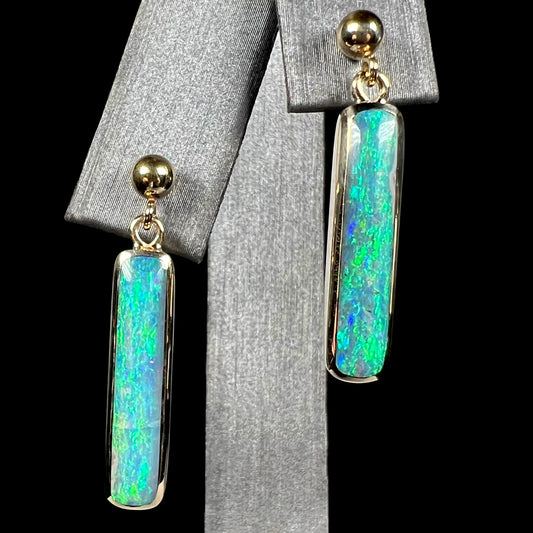
Collection: Yellow Gold Opal Jewelry

Gold, As It Has Always Been.

Yellow gold has remained the defining standard of fine jewelry for millennia—its natural color unchanged, its presence immediately recognizable, and its warmth uniquely suited to opal.


Yellow Gold Opal Jewelry: A Collector's Overview

OpalPop’s collection of yellow gold opal jewelry includes rings, pendants, earrings, and bracelets crafted from solid yellow gold across a wide range of karat purities.  Some pieces incorporate sterling silver elements with solid yellow gold accents, while others feature subtle combinations with white or rose gold.

Yellow gold–plated and gold-filled pieces are intentionally excluded from this collection, allowing those seeking solid gold opal jewelry to browse with confidence in the materials used.

In our broader Gold Opal Jewelry guide, we explore how “gold” represents a spectrum of choices—spanning color, purity, and cultural context.  Here, the focus narrows to yellow gold itself: its history, its visual identity, what it signals, and how different purities influence its appearance.

A Brief History of Yellow Gold

As the natural, unchanged color of gold in its pure form, yellow gold has been used in jewelry for thousands of years.  Some of the earliest documented examples date to the Varna Necropolis in Bulgaria, around 4,500 BC, where gold jewelry was buried alongside individuals believed to be of high social standing.

From antiquity through the modern era, yellow gold has served as jewelry, currency, and religious artifacts—consistently functioning as a visible marker of wealth and status.

In more recent centuries, its physical properties have also made it valuable in technical fields.  Yellow gold’s biocompatibility has led to widespread use in dentistry, while its conductivity has made it essential in electronics.  By contrast, alloyed variations such as white gold introduce additional metals that alter or diminish these properties.

The Cultural Role of Yellow Gold

In Western, Trend-Driven Markets

In the United States and much of Europe, jewelry trends shift frequently.  Within this cycle, yellow gold is often treated as one of several rotating color options, alongside white and rose gold.

The opal market saw a notable surge in the 1980s—a period when yellow gold was widely favored across Western jewelry.  Many vintage pieces from this era remain in circulation today, particularly modernist designs set with Australian opals, which were more abundant at the time.

By the 1990s and early 2000s, white gold rose in popularity, echoing earlier Art Deco preferences.  That shift has persisted for decades, contributing to a modern perception of yellow gold as “vintage” or “retro.”  While trend cycles suggest a potential resurgence, these patterns are inherently unpredictable.

In Eastern and Middle Eastern Traditions

In contrast to Western trend cycles, many Asian, Indian, and Middle Eastern markets maintain a consistent preference for yellow gold.  Here, gold is not simply decorative—it is cultural, symbolic, and often tied directly to wealth preservation.

Higher karat gold is especially valued.  While 14k dominates the U.S. market, 18k, 22k, and even 24k are commonly worn elsewhere.  In these contexts, deeper, more saturated yellow tones are not considered excessive—they are expected.  The intensity of the color itself reinforces the metal’s status.

In Islamic tradition, gold carries an additional cultural distinction.  Based on teachings attributed to Prophet Muhammad, the wearing of gold is generally reserved for women, while men are strictly prohibited from wearing it—considered haram, or forbidden.  This has historically reinforced yellow gold’s association with femininity in many Muslim-majority regions, while men more commonly wear alternative metals such as silver or platinum.

What Wearing Yellow Gold Jewelry Signals

Jewelry does not exist in isolation.  Metal choice—especially in gold—contributes to how a piece is perceived.

Yellow gold has long carried associations of wealth, status, and permanence.  Its color is immediately recognizable, and its use across centuries gives it a sense of continuity that other metals do not replicate.

In contemporary Western settings, where white gold has dominated for decades, yellow gold often reads as traditional.  It can suggest stability, familiarity, and a preference for established forms over trend-driven alternatives.

At the same time, perception depends on context.  The same piece can read differently depending on how it is worn.

With rising gold prices, gold-plated and gold-filled jewelry has become increasingly common.  These materials are not new—plating techniques date back to ancient Egypt—but their prevalence has altered how gold is perceived in modern markets.

As a result, the visual signal of yellow gold is no longer determined by color alone.  Material, construction, and presentation all contribute to how it is interpreted.

Skin Tone & Opal Pairing

For those without a strong preference, color compatibility can help guide selection.

Yellow gold’s warmth tends to complement warm, olive, and neutral skin tones.  Its color also pairs naturally with opals that display red, orange, or yellow play of color and body tones—particularly fire opals from Mexico and Ethiopia.

Because opals vary widely in body tone and play-of-color, metal choice can subtly influence how those colors are perceived.

How Karat Affects the Color of Yellow Gold

Karat purity directly influences how yellow gold appears.

Higher karat gold contains more pure gold, resulting in a richer, more saturated yellow tone.  Lower karat alloys introduce additional metals, which can lighten or alter the color.

10k Yellow Gold

The lowest commercially produced purity standard in the United States, 10k yellow gold has a noticeably lighter, more subdued color—often appearing pale, with a faintly silvery or near-white cast when freshly polished.

With approximately 41.7% pure gold and 58.3% alloy by weight, many 10k alloys—particularly older, copper-heavy formulations—develop a darker, slightly brown patina over time.  This effect is common across low-karat golds and is frequently seen in vintage pieces, including English 9k yellow gold.

14k Yellow Gold

The American standard, 14k yellow gold offers a balanced composition of gold and alloy.  Its color ranges from a soft, slightly muted yellow to a more defined tone, depending on the specific alloy used.

Vintage 14k alloys—especially those with higher copper content—may develop a subtle surface darkening over time, though typically less pronounced than in 10k yellow gold.

18k Yellow Gold

With 75% pure gold, 18k yellow gold displays a noticeably richer, more saturated color.  Even lighter-toned 18k alloys tend to appear deeper than 14k and below.

Because of its higher gold content, 18k gold is less prone to the type of surface darkening seen in lower-karat alloys.

22k & 24k Yellow Gold

Less common in the United States but widely used internationally, 22k and 24k gold are immediately recognizable for their intense yellow to orangish-yellow color.

At 99.9% purity, 24k gold contains no alloying metals to influence its color, making it the purest expression of yellow gold.

Recycling Yellow Gold

Rising gold prices have increased interest in recycling existing gold into new jewelry.

Most historical yellow gold alloys are broadly compatible with one another, allowing gold from different eras and purities to be melted and reused without significantly compromising structural integrity.  This flexibility makes yellow gold particularly sustainable and well-suited for reuse in custom jewelry.

This is not always the case with white gold, where alloying elements such as nickel or zinc can behave unpredictably when reheated and combined.

A Note on Dental Gold

Despite its similar yellow appearance, dental gold used for teeth and cavity fillings cannot be repurposed into new jewelry.  Dental alloys often contain palladium—a platinum-group metal added for strength and durability—which alters how the material behaves when melted.

While unsuitable for reuse in fabrication, dental gold still retains its intrinsic value and is commonly sold to refiners.

For Further Reading

To see how yellow gold interacts with different opal varieties in a more personal, wearable context, explore our Yellow Gold Opal Rings collection guide.

For a closer look at how yellow gold defines presence, visibility, and design across statement pieces, visit our Yellow Gold Opal Necklaces collection guide.

Dig Deeper

Explore more curated collections similar to Yellow Gold Opal Jewelry: