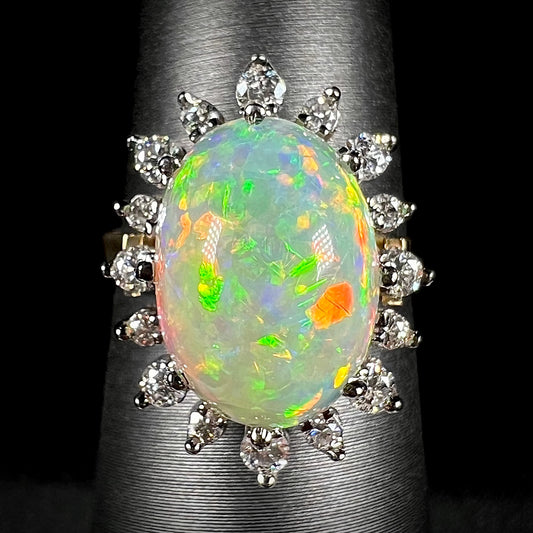
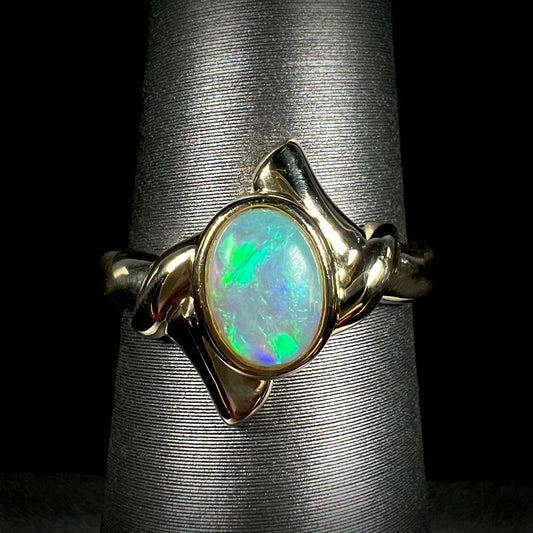
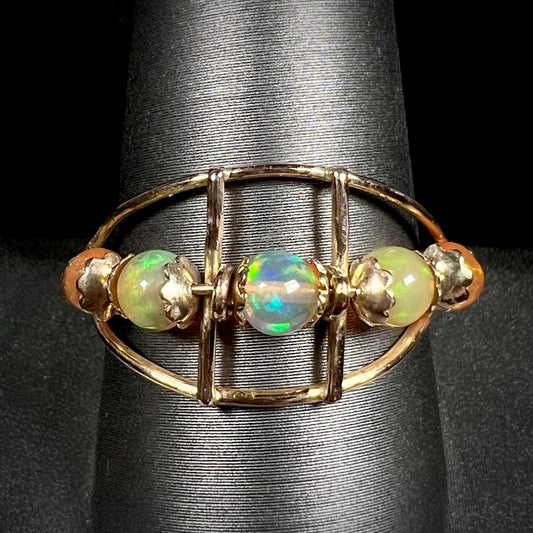
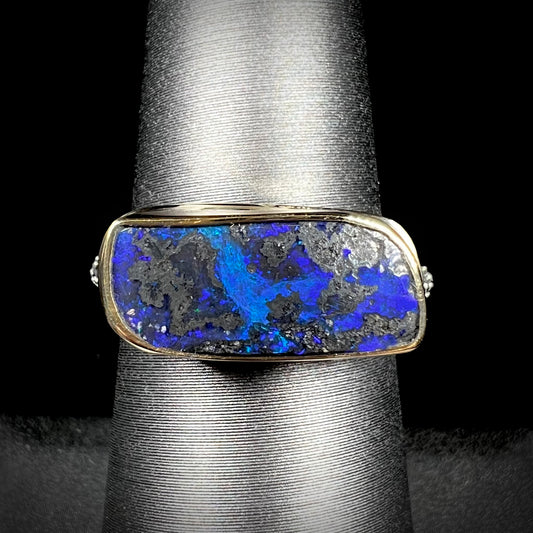
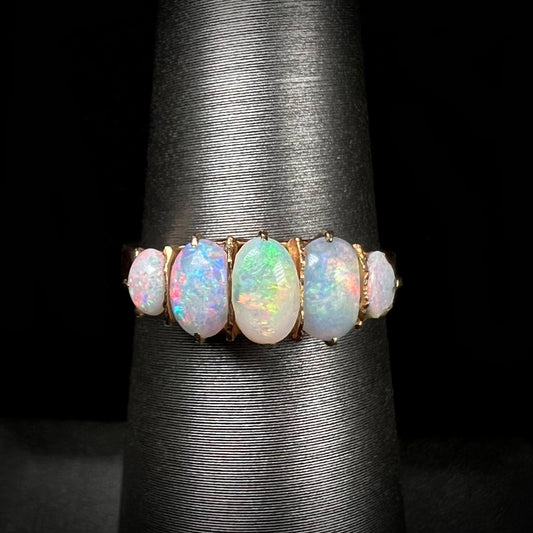
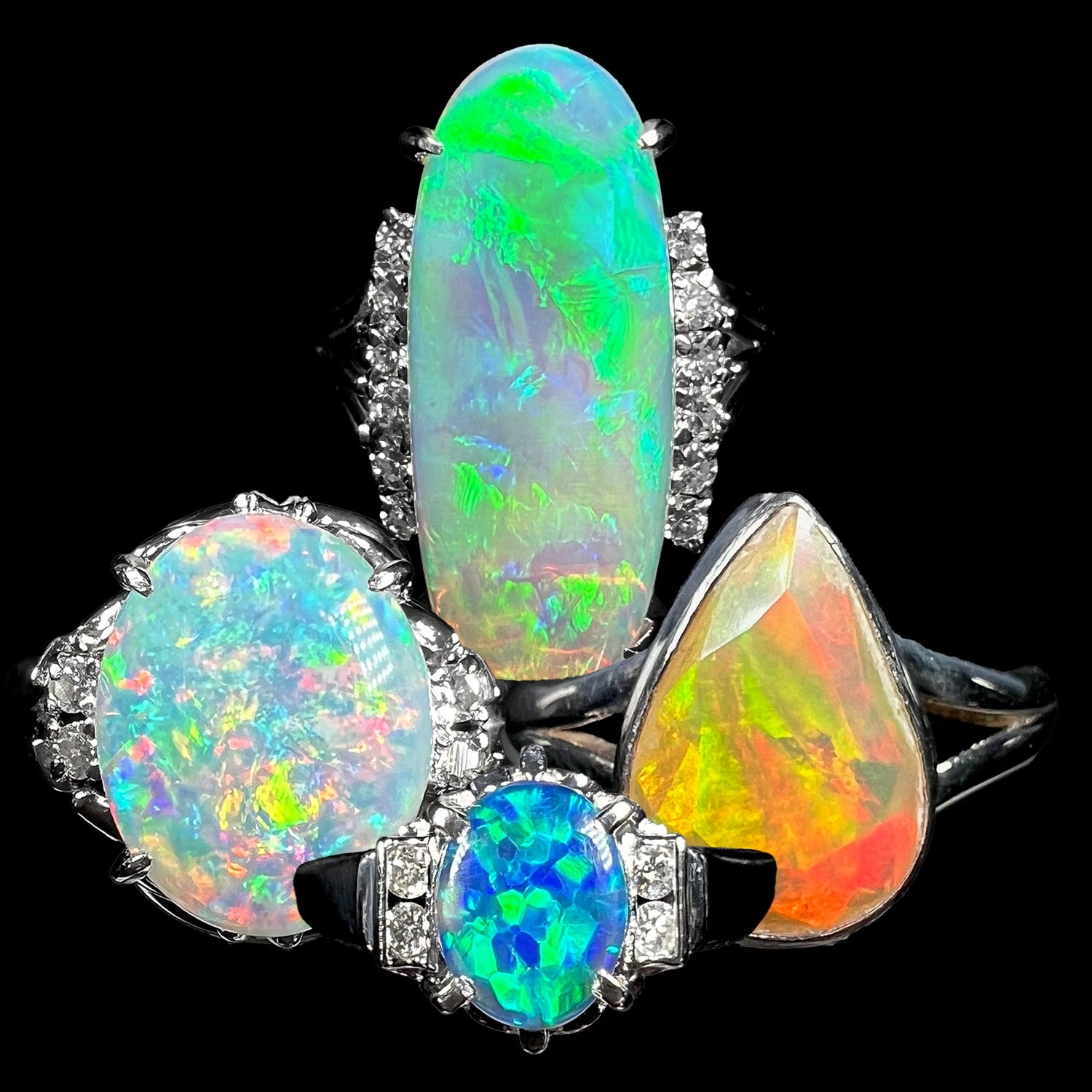
OpalPop’s selection of 18k gold opal rings features pieces sourced from around the world—modern, vintage, and antique. Most rings are entirely 18k gold and set with natural, collector-grade stones, though occasional mixed-metal or mixed-karat examples appear. The collection’s defining trait is that every piece contains some meaningful element of solid 18k gold. Gold-plated and gold-filled rings are intentionally excluded so buyers seeking true 18k gold can browse with confidence.
In our broad Gold Opal Rings collection, we explore the concept that “gold” is more than a single metal choice, but an entire category spanning colors, karat purities, durability considerations, cultures, and lifestyles. In our 18k Gold Opal Jewelry guide, we take a closer look at 18k specifically—its higher intrinsic value, historical significance, richer color, and the hallmark systems used to identify likely origin countries.
Here, the focus narrows further to 18k gold opal rings: what distinguishes them from lower-karat alternatives, how they wear over time, the styles and opal varieties most commonly associated with them, and guidance tailored specifically for engagement ring shoppers.
18k Gold Opal Rings: Finer Purity, Higher Standards
Across the United States and much of the world, 18k gold has long been associated with jewelry intended for a more refined and discerning audience. Compared to standard 14k gold rings, 18k gold carries higher intrinsic value, greater weight, and richer color in 18k yellow gold rings. Because of these increased costs, designers, artisans, and collectors have historically reserved 18k construction for finer craftsmanship and higher-grade gemstones.
These desirable traits come with one practical tradeoff: lower durability relative to lower-karat gold alloys.
Wearing and Caring For Your 18k Gold Opal Ring
Rings generally absorb more cumulative wear than any other jewelry type. Simple daily actions—gripping a steering wheel, opening doors, lifting objects, reaching into bags or pockets—gradually affect both the gemstone and mounting over time. Wear accelerates significantly during more rigorous activities such as gardening, washing dishes, weightlifting, or working with tools.
The Durability of 18k Gold Rings
Pure 24k gold is soft, highly malleable, and prone to scratching and deformation. By alloying pure gold with additional metals, these traits are reduced in 18k gold—but they remain more noticeable than in lower-karat alloys with higher percentages of hardening metals.
Those with sharp attention to detail will notice fine surface scratches forming more quickly on 18k gold rings than on pieces made from 14k or 10k gold, particularly along the bottoms of shanks and broad bezel surfaces. Most light wear can be polished professionally during routine servicing, though deeper gouges are more difficult to fully remove.
Prong settings also require more regular inspection. Because 18k prongs wear faster than lower-karat gold alloys, annual prong checks become especially important. Losing any gemstone is unfortunate, but many 18k rings feature fine opals that are both costly and difficult to replace. Some luxury designs mitigate this issue by utilizing platinum prongs, which generally require servicing far less frequently.
Thin or lightweight 18k ring shanks should also be worn thoughtfully. Due to 18k gold’s greater malleability, repeated stress—particularly when lifting heavy objects using the underside of the hand—can gradually distort a ring’s shape or, in extreme cases, crack thinner sections entirely. Over long periods of wear, it is natural for 18k rings to subtly conform to a wearer’s finger shape, but unnecessary stress accelerates and exaggerates this process considerably.
The Durability of Any Opal Ring
At OpalPop, we stress that opal is a delicate gemstone and should always be treated as though it were glass. Sharp impacts and abrasive surfaces should be avoided whenever possible. Bezel settings that fully surround the stone are generally safer than open prong mountings that expose delicate edges.
Most opal varieties are safe to wet through routine activities such as hand washing or bathing. The primary exceptions are Ethiopian opals and assembled opals such as doublets and triplets, though assembled stones are less commonly encountered in 18k gold rings. Harsh chemicals—including jewelry cleaners, perfumes, lotions, and hand sanitizers—should be avoided around all opal varieties.
Designed for Longevity, Not Abuse
Though 18k gold is less durable than lower-karat alternatives, the level of care required to safely wear opal rings already exceeds what is necessary to preserve an 18k mounting. Properly made 18k rings are not fragile objects that require constant fear or avoidance; many antique examples over a century old still survive in remarkable condition today, even when mounted with opals.
When worn thoughtfully and spared from unnecessary abuse, 18k gold opal rings are fully capable of lasting generations.
Popular Styles & Trends of 18k Gold Opal Rings
Designer Opal Rings
The United States experienced a major influx of fine Australian opal imports during the 1980s and 1990s. Exceptional Lightning Ridge black opals and Queensland boulder opals inspired a number of talented independent American artisans to not only craft jewelry, but to learn the process of cutting opal itself.
Rings from this era frequently feature low-set stones mounted in artistic Modernist-style 14k and 18k gold settings. Some artists became particularly prolific and collectible, with Laguna Beach jeweler Luciano Bortone standing among the most recognizable names associated with late-20th-century American opal jewelry.
Following major Ethiopian opal discoveries beginning in 2008, large luxury-oriented design houses increasingly adopted Ethiopian opals for their higher-end 18k collections. Though manufactured in quantity overseas, these limited-run pieces are often constructed heavily and paired with fine accent stones. Le Vian became particularly associated with 18k rose gold opal rings, a pairing that saw strong popularity during the 2010s.
White Gold Art Deco Opal Rings
Estate examples from the 1920s and 1930s Art Deco era occasionally appear in fine secondary markets and vintage boutiques. During this period, platinum opal rings were extremely costly due to earlier wartime restrictions on platinum production and usage. White gold emerged as the jewelry industry’s practical alternative.
Many 18k white gold opal rings from the Art Deco period feature white or crystal opals mounted in highly architectural designs accented by filigree work. The finest examples, however, often center around vivid Lightning Ridge black opals.
Antique Victorian & Edwardian Opal Rings
Well-preserved examples of Edwardian 18k opal rings from the early 1900s can still occasionally be encountered today. These rings often feature horizontal rows of Australian white or crystal opals, sometimes accented by diamonds.
British examples frequently contain a series of small rectangular hallmarks stamped inside the shank, indicating a ring’s purity, city of manufacture, and precise production year when still visible. American-made pieces from the same period more commonly display only the karat purity stamp.
Victorian-era opal rings from the 1800s often follow similar multi-opal layouts accented with seed pearls or old-cut diamonds, though true 18k examples are notably rarer than stylistically comparable 9k gold versions.
Fraudulent 18k Thai Princess Rings & Cluster Rings: A Warning
Across vintage jewelry stores, pawn shops, inherited family collections, and secondary marketplaces, one particular category of ring appears repeatedly: handmade Thai cluster rings and princess rings fraudulently stamped “18k.”
The earliest forms of these rings—commonly called Thai princess rings or harem rings—featured tall domed structures with interchangeable gemstone tops secured through a bolt mechanism underneath the setting. These rings became popular souvenirs among American and British servicemen stationed in Thailand during and after WWII. By the Vietnam War era, related cluster-ring styles had evolved into larger, louder designs influenced by atomic motifs, Brutalism, and open freeform construction.
Though these rings are routinely stamped “18k,” most test substantially lower in purity. Actual gold content commonly ranges from roughly 14k on the high end down to 6k, with unusual intermediate purities such as 8k and 12k frequently encountered. One visible indicator is the rapid development of dark brown copper patina, giving a tarnished appearance—something inconsistent with true 18k gold.
Despite widespread misrepresentation across the vintage market, these rings still hold legitimate historical and collectible value. At OpalPop, every piece is professionally tested before documentation regardless of hallmark stamp, and all findings are clearly disclosed within product titles and descriptions.
Guidance for The Opal Engagement Ring Shopper
Though 18k gold requires slightly more attentive wear than lower-karat alloys, that additional care rarely exceeds what is already required for any opal engagement ring. For buyers seeking the finest standard gold alloy and associated opal quality in the Western jewelry market, 18k gold remains the premier choice.
A few considerations are especially important:
- Bezel settings are generally safer than exposed prong designs.
- Fine opals are often significantly more difficult and expensive to replace than commercial-grade material.
- 18k rings are best treated as long-term investments intended for thoughtful wear rather than constant physical activity.
- Yellow, white, and rose gold preferences should always be discussed with the recipient beforehand, as metal color preference alone can strongly influence long-term satisfaction with the ring.