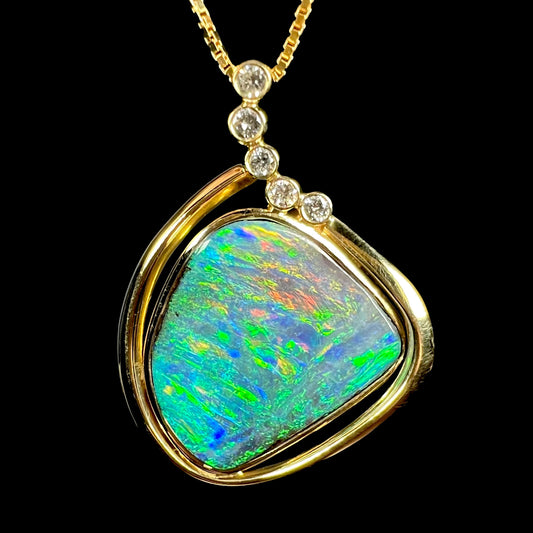
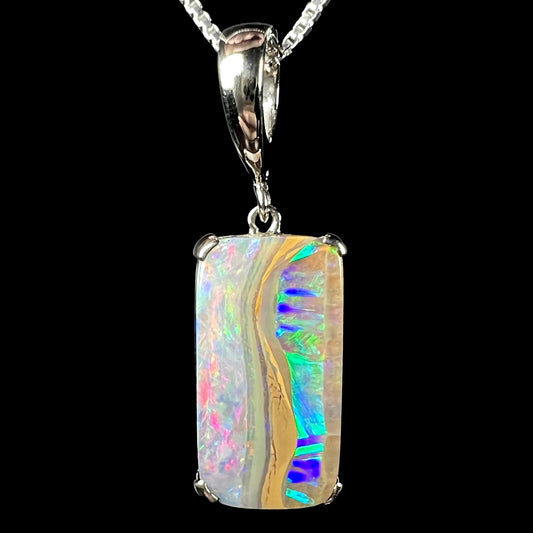
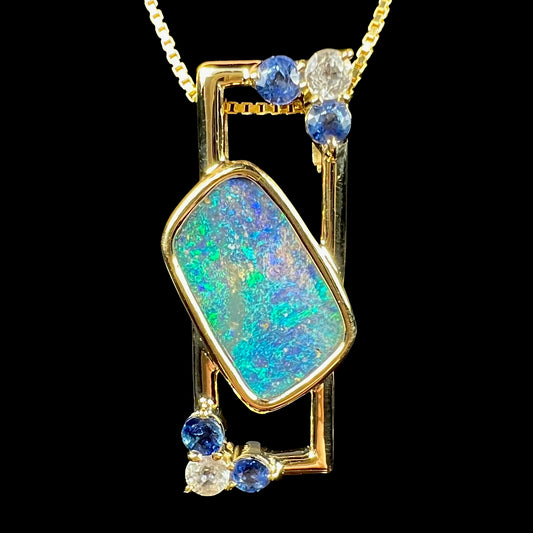
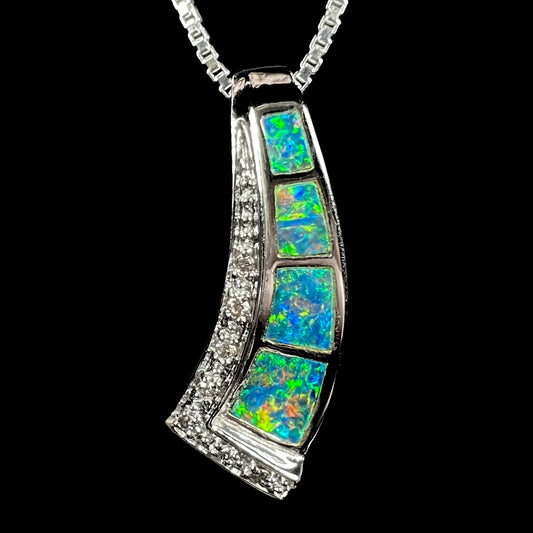
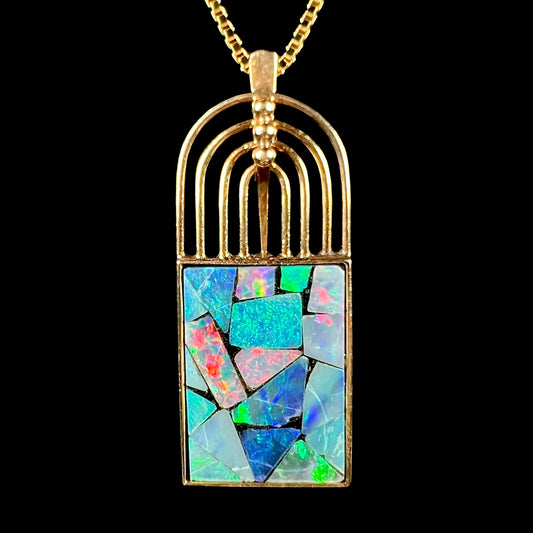
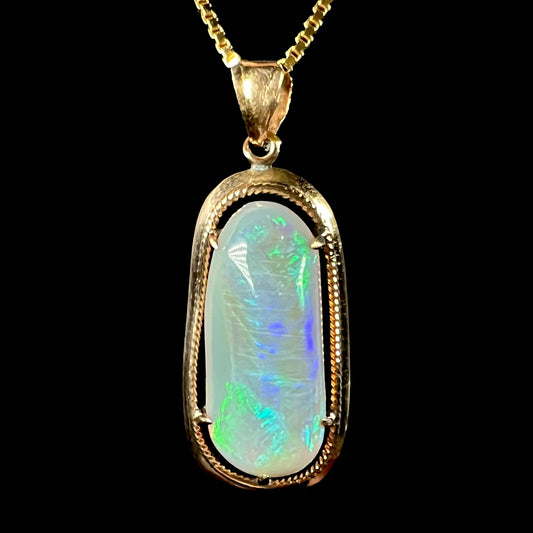
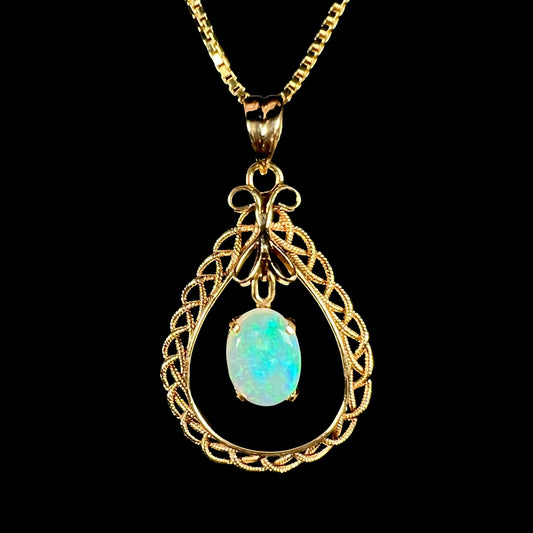
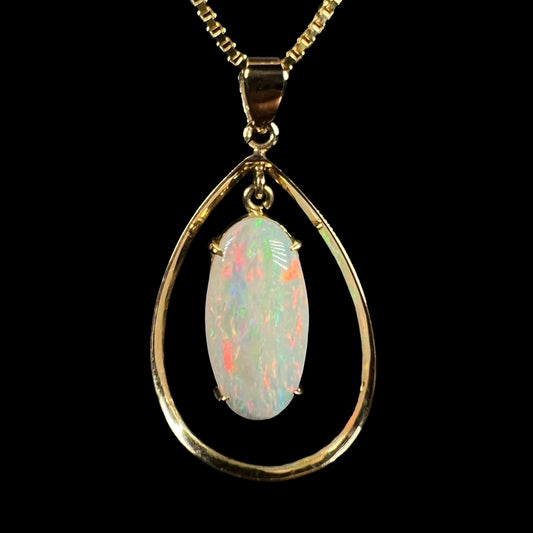
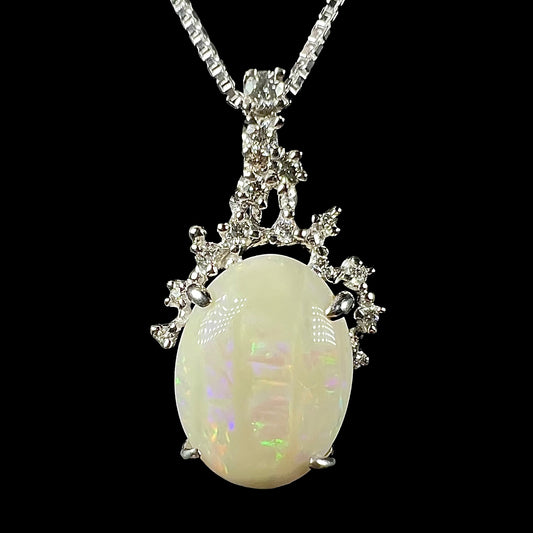
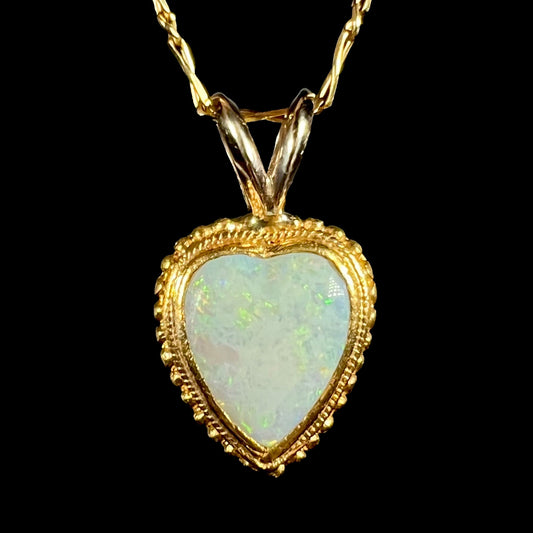
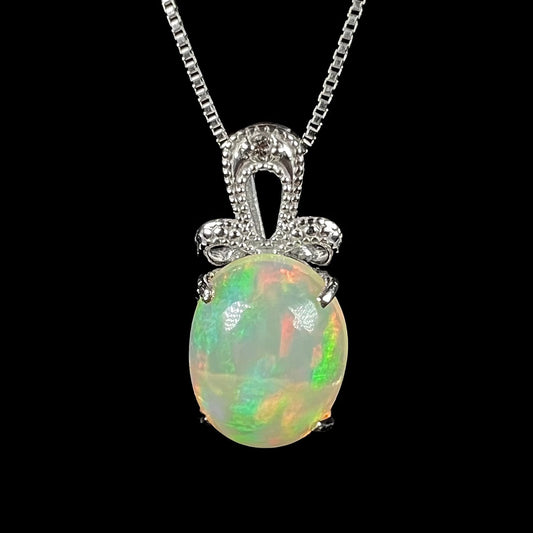
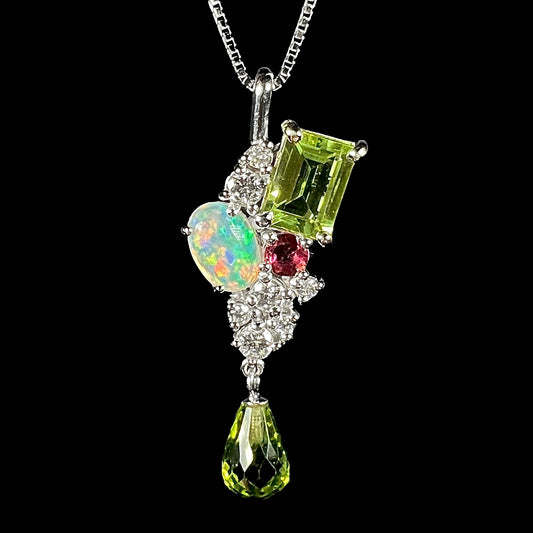
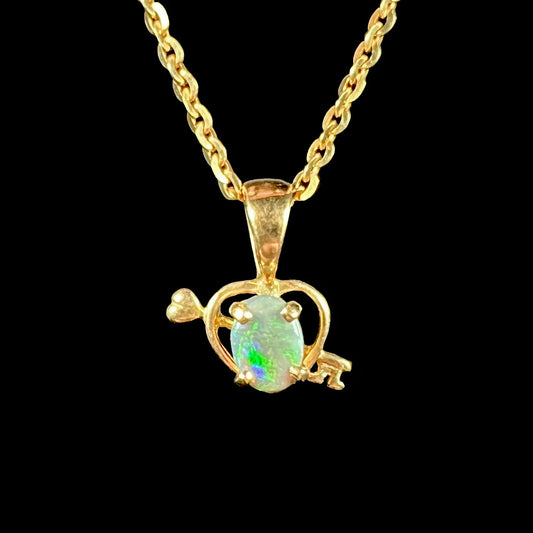
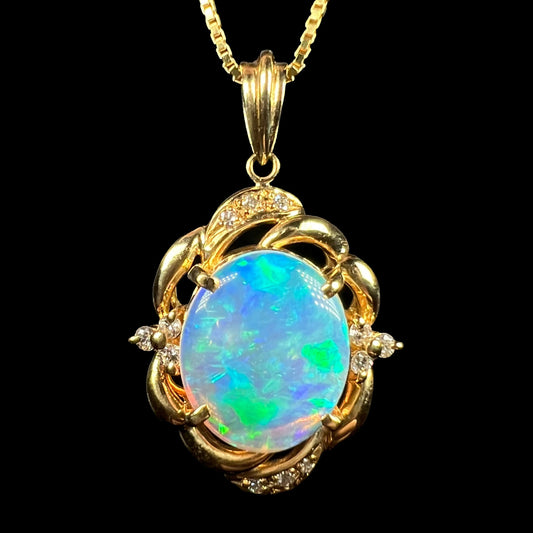
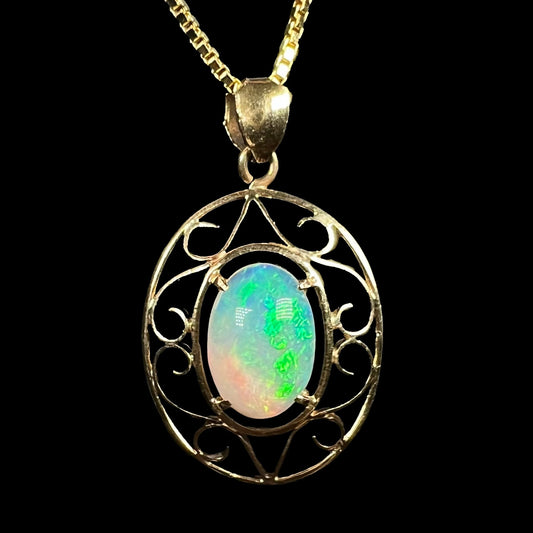
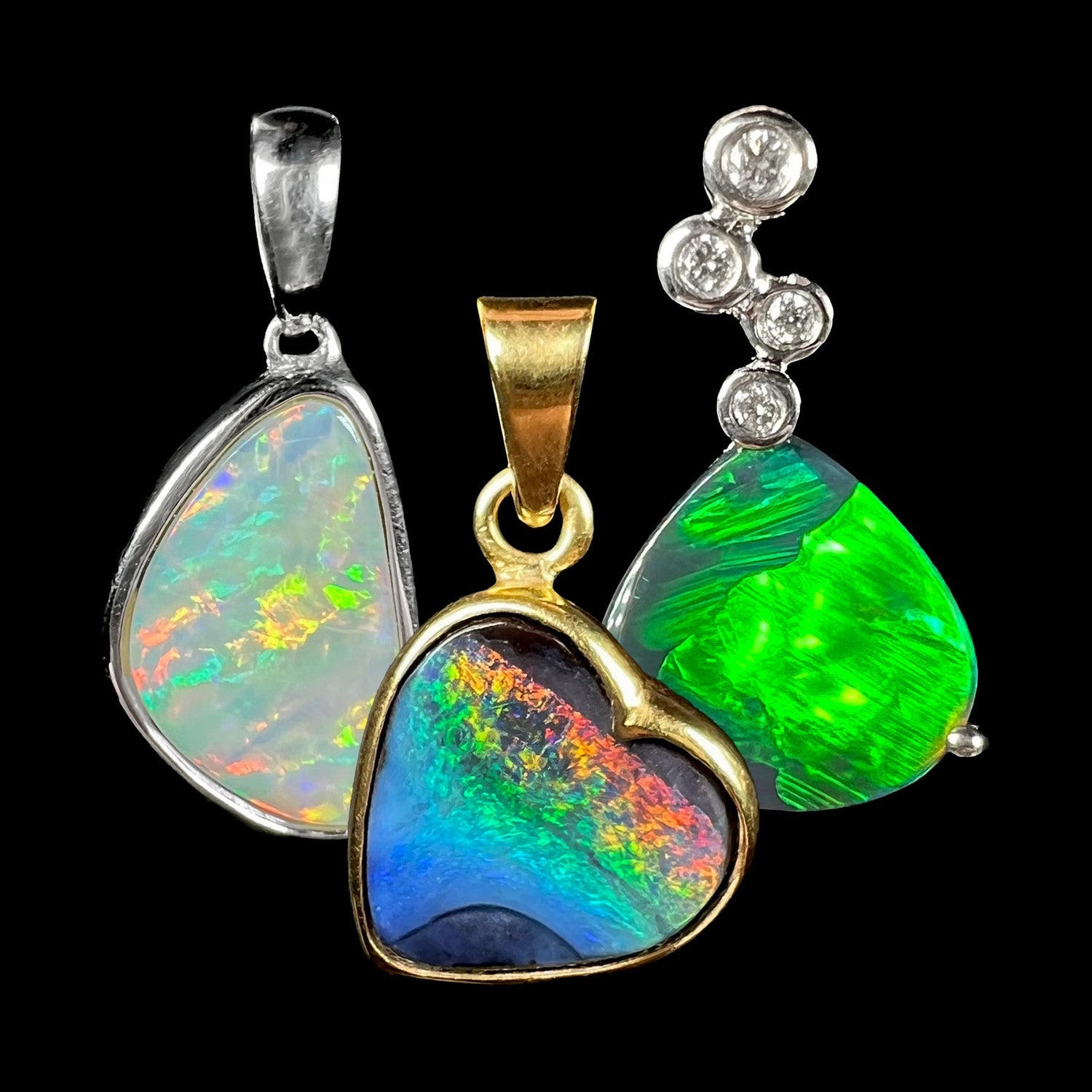
OpalPop’s selection of 18k gold opal necklaces features pendants sourced from around the world, most set with natural opals. Fine Australian and Ethiopian opals are primarily represented, with pieces ranging from vintage to modern and originating from the United States, Japan, the United Kingdom, and beyond. Gold-plated and gold-filled pendants are intentionally excluded so shoppers seeking solid 18k gold options can browse with confidence.
Every OpalPop pendant includes a complimentary presentation chain so it can be enjoyed right out of the box. These chains are often sterling silver, plated when appropriate to complement the pendant’s color, though select pieces may include matching 18k gold chains or cords. Specific chain details are always noted within each product description.
In our general Gold Opal Necklaces collection, we explore gold as a broad category spanning colors, karat purities, and market positions. In our 18k Gold Opal Jewelry guide, we discuss what gives 18k gold its luxury association, including its global history, higher intrinsic value, and the hallmark systems used to identify 18k gold jewelry from different regions.
Here, the focus narrows specifically to 18k gold opal necklaces: how to care for them properly, what makes their construction different from lower-karat options, and the pendant styles most closely associated with fine opal jewelry around the world.
18k Gold Opal Necklaces: The Investment That Tells a Story
Few jewelry categories speak as publicly as a pendant. Every detail is visible—the featured opal, metal color, design style, craftsmanship, scale, and balance. Because opals are naturally individual stones, talented designers often use their shapes, patterns, and play-of-color to create pieces that feel truly one of a kind.
18k gold is the most valuable standard gold purity commonly used in American jewelry. Because of its higher material cost, American jewelers often reserve it for finer work and finer gemstones. Producing an 18k gold pendant requires more capital from the jeweler and a higher investment from the buyer, but that premium brings added weight, stronger intrinsic gold value, and—in 18k yellow gold necklaces—a richer underlying gold color.
It is worth noting that exceptional opals can also appear in American-made 14k gold opal pendants, as 14k gold remains the country’s broad benchmark purity. The difference is that 18k gold more often signals a deliberate move toward the luxury tier, especially when paired with fine Australian black opal, boulder opal, crystal opal, or high-grade Ethiopian opal.
Properly Caring for an 18k Gold Opal Necklace
Because a necklace can be lost from a single point of failure, care and inspection are especially important. This is even more true for 18k gold opal necklaces, where both the gold content and featured stones are often more valuable and difficult to replace.
The Reality: 18k Necklaces Wear Faster
The higher a gold’s karat purity, the softer it becomes. 18k gold chains and pendant bails wear faster than lower-karat options, particularly when paired with harder metals such as 10k or 14k gold.
This does not mean that 18k gold necklaces are fragile or impractical. It means they deserve attention. A well-made 18k gold pendant can last for generations, but the most important wear points should be checked periodically—especially on daintier pieces or necklaces worn often.
Key areas to inspect include:
- The pendant bail: The bail is the section where the chain passes through the pendant. Over time, the chain can create grooves along the bail’s inner edges. If ignored, this wear can eventually cut through the bail entirely.
- Clasp attachments: The links, jump rings, or purity tags connecting the clasp to the chain can stretch or thin over time. If these areas look worn, the chain should be inspected by a jeweler.
- Lobster clasps: Open the clasp and allow it to snap shut. A healthy clasp should close quickly with a crisp sound. A slow or “mushy” clasp may be dirty, worn, or nearing failure.
Unlike many 14k gold lobster clasps that use base-metal internal springs, higher-end 18k clasps incorporate solid gold internals and are more costly to replace. If a clasp feels weak after gentle cleaning with warm, soapy water and a soft toothbrush, it should be treated with caution until professionally replaced.
Remove Necklaces Before Sleeping
This guidance applies to any fine necklace, but it is especially important for 18k gold. Wear does not stop when the wearer falls asleep; movement, gravity, and the sliding of a pendant along a chain all continue through the night.
Necklaces should also be clasped closed when removed to reduce tangling. When setting down an opal pendant, place it gently and avoid abrasive surfaces. The density of 18k gold can make a pendant land with more force than expected, and opals should always be handled with care.
Water Exposure & Perfumes
Most opal varieties are safe to wet, but thinner 18k chains should still be removed before showering to avoid unnecessary stress on delicate links.
Ethiopian opals, opal doublets, and opal triplets should not be exposed to moisture. Doublets and triplets are less common in 18k gold pendants, but they should still be treated carefully when present.
Perfumes, deodorants, hair sprays, lotions, and other products should be applied before wearing an opal necklace. Harsh chemicals should be kept away from all opal varieties whenever possible.
White Gold Necklace Skin Sensitivities
Gold is not naturally white. White gold is created by adding white alloying metals to yellow gold, with nickel being one of the most common whitening alloys used in the United States. Some wearers are sensitive to nickel and may experience itching, irritation, or rashes after prolonged contact.
Some people with mild sensitivities tolerate 18k white gold necklaces better than lower-karat white gold because 18k contains less added alloy overall. Still, anyone with a known nickel allergy should assume a reaction is possible unless they already know how their skin responds to 18k white gold.
For those who love an 18k white gold pendant but cannot comfortably wear white gold against the skin, the pendant may often be worn on a sterling silver chain, provided the pendant rests over clothing and does not contact the skin directly.
Popular 18k Gold Opal Pendant Styles
Vintage Modernist & Artistic Pendants
During the 1980s and 1990s, imports of fine Australian opal into the United States were exceptionally strong. Large freeform opals—especially boulder opals and other stones with dramatic play-of-color—were often best suited for pendant designs, where scale and irregular shape could become part of the composition.
This helped extend the life of the Modernist jewelry aesthetic within the opal world. Freeform Australian boulder opals were especially well suited to asymmetrical 18k gold pendant designs, where the metal could frame the stone without forcing it into a standard calibrated shape. Fine doublets were often mounted into similar 14k gold versions, while solid high-grade boulder opals were more frequently reserved for 18k examples.
Many pendants from this era feature clip-on enhancer bails, allowing them to be worn on heavier chains, omega necklaces, or bead strands.
Beyond abstract Modernist forms, artists have also used 18k gold to create more literal opal scenes—forests, swans, lakes, cityscapes, and architectural motifs where the opal becomes part of the image itself. These pieces reflect one of opal jewelry’s greatest strengths: the ability of the stone’s natural pattern to guide the design.
Japanese-Crafted 18k Gold Pendants
18k gold has long been one of Japan’s favored fine jewelry metals, second only to platinum in many high-end contexts. Older Japanese opal pendants were often made in 18k yellow gold, while 18k white gold pendant designs became more common around the 1990s as white gold jewelry continued gaining popularity.
Japan became a significant buyer of fine Australian and Mexican opals from roughly the 1940s through the 1980s. During this period, Japanese jewelers mounted opals in 18k gold and platinum pendant settings, often emphasizing precision, documentation, and refined construction.
Economic headwinds beginning in the 1990s slowed Japan’s ability to purchase fine opals at the same scale, though the preference for high-purity metals largely remained. For this reason, Japanese 18k opal pendants can be found with a wider range of opal qualities than is typical in American luxury positioning.
Japanese 18k jewelry is commonly identified by the hallmark “K18,” with the “K” placed before the purity number rather than after it.
Modern Designer Brand Pendants
The first decades of the 21st century have been shaped heavily by large design houses and overseas manufacturing. While mass production is often associated with lower-cost jewelry, many designers have also expanded into premium lines using 18k gold, diamond accents, and fine opals.
Following major Ethiopian opal discoveries beginning in 2008, fine Ethiopian opals became increasingly important in modern designer pendants. Their brightness, availability, and consistency made them attractive for larger-scale luxury production.
Le Vian is one notable designer brand in this space, known for bold statement pieces and for helping repopularize 18k rose gold opal necklaces during the 2010s.