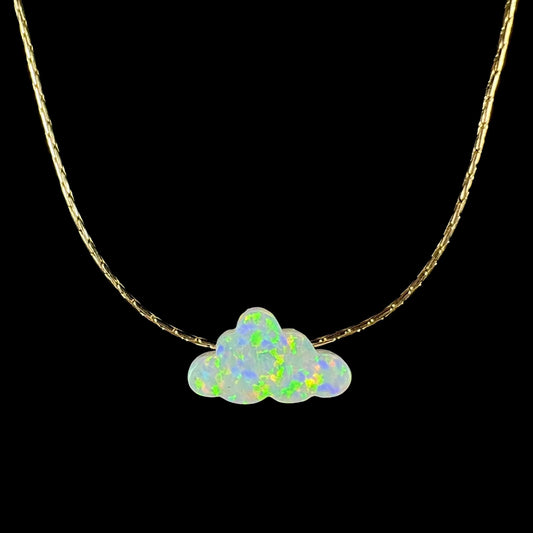
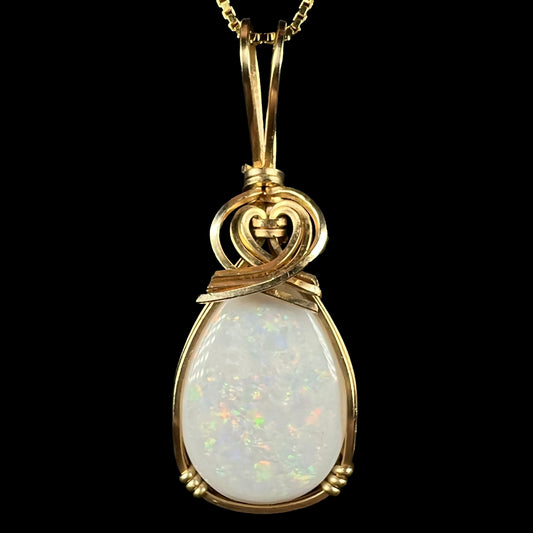
OpalPop’s limited selection of gold-filled opal jewelry features occasional handmade pieces by independent artists, including designs set with natural polished and rough opals, as well as commercially produced pieces featuring lab-created opals, doublets, or triplets. Gold-plated jewelry is intentionally excluded from this collection so buyers seeking higher-quality gold-filled opal jewelry can browse with confidence.
In our adjacent Gold Opal Jewelry collection, we discuss the broader world of solid gold jewelry, including color, karat purity, and terms such as gold-plated and gold-filled. Here, the focus narrows specifically to gold-filled jewelry: what it is, how it differs from solid gold and gold plating, how to identify it, and how to care for gold-filled pieces set with opals.
What is Gold-Filled Jewelry?
Gold-filled jewelry is not solid gold. Despite the name, it is a bonded metal product made by applying thick sheets of solid gold alloy—typically 10k, 12k, 14k, or 18k gold—to a non-gold core. In most cases, that core is brass or copper, though sterling silver may occasionally be used in finer work. Put simply, the base metal is sandwiched between layers of real gold.
Most commercial gold-filled jewelry is made with yellow gold, giving it the warm appearance many buyers associate with traditional gold jewelry.
Under United States FTC guidelines, gold-filled jewelry must contain at least 1/20th gold alloy by weight, or 5% of the total piece. This 1/20th standard is the most common composition, though some finer or vintage pieces may contain 1/10th gold, or 10%, and occasionally 1/8th gold, or 12.5%.
It is important to understand that this percentage refers to the stated gold alloy—not pure 24k gold.
For example, if pure 24k gold were hypothetically valued at $145 per gram, a 1 gram piece of 1/20th 12k gold-filled jewelry would not contain $7.25 worth of pure gold. Because 12k gold is only 50% pure gold, the actual pure gold value would be approximately $3.62.
Gold-Filled vs. Gold-Plated Jewelry
Gold-filled jewelry is significantly different from gold-plated jewelry.
Gold-filled construction bonds sheets of solid gold alloy to a base metal core using heat and pressure. The resulting gold layer is far thicker and more durable than standard plating. Gold-filled layers are commonly around 20 to 35 microns thick, while ordinary gold plating may be only 0.1 to 2.5 microns.
That difference matters.
Gold plating is a thin electrochemical wash that can wear away quickly, sometimes within months depending on wear, polishing, skin chemistry, and exposure to moisture or chemicals. Gold-filled jewelry, by contrast, can often last 10 to 30 years when cared for properly.
Is Gold-Filled Jewelry Real Gold?
Yes and no.
Gold-filled jewelry contains real gold, but it is not solid gold jewelry and should never be presented as solid gold. It belongs in a separate material category.
That said, gold-filled jewelry is far superior to ordinary gold-plated costume jewelry. The gold layer is thicker, more durable, and more meaningful from both a wear and material standpoint.
Gold-filled pieces are also frequently set with natural gemstones. In gold-filled opal jewelry, Australian white opals, boulder opals, and rough Ethiopian opals are among the natural stones most commonly seen. Many small-scale independent artists use gold-filled wire and findings as a material that sits above base-metal costume jewelry and, in some contexts, alongside sterling silver jewelry as an accessible handmade medium.
This is especially common in wire-wrapped designs, where gold-filled wire is widely available to artists, hobbyists, and small studio jewelers.
Gold-Filled vs. Rolled-Gold Jewelry
Rolled-gold jewelry is made using a similar construction method: a base metal core is bonded to sheets of gold alloy. The key difference is thickness.
Gold-filled jewelry must contain at least 1/20th gold alloy by weight under United States standards. Rolled-gold jewelry typically contains less—often somewhere between 1/20th and 1/50th gold by weight.
Rolled-gold jewelry is often stamped “RGP,” meaning rolled gold plate. It was first invented and widely popularized in 1800s England, where it became a durable, cost-effective option for Victorian jewelry when solid 9k gold jewelry was still too expensive for some buyers.
The material also became popular in the United States, especially for pocket watches and related accessories during the 19th and early 20th centuries. Over time, rolled gold declined in favor of thicker gold-filled construction, though antique rolled-gold pieces remain common on the secondary market.
Caring For & Cleaning Gold-Filled Opal Jewelry
Gold-filled jewelry lasts far longer than gold-plated jewelry, but it is not indestructible. It has its own care expectations, especially when set with opals.
The metal itself can generally tolerate water, but harsh soaps, shampoos, perfumes, sanitizers, and lotions may leave film or accelerate surface wear. Older gold-filled pieces, particularly those with copper-containing cores, may also darken or develop greenish tarnish over time. This is most often seen in rings, where skin acids remain in close contact with the metal, and the process usually develops gradually.
To clean gold-filled jewelry, use warm water mixed with mild hand soap or dish soap. Let the piece soak briefly, then gently clean the metal with a soft-bristled toothbrush. The toothbrush should be genuinely soft to avoid damaging the bonded gold layer.
Opal care requires additional caution:
- Australian opals and lab-created opals are generally safe to wet.
- Ethiopian opals should not be soaked or exposed to water.
- Opal doublets and triplets should not be soaked or exposed to water.
- Chemical jewelry cleaners should be kept away from all opals whenever possible.
For Ethiopian opals, doublets, or triplets, clean only the metal areas carefully and avoid soaking the piece.
Identifying Gold-Filled Jewelry
Fraction Hallmark Stamps
The most reliable first clue is the hallmark.
Gold-filled jewelry is often stamped with a karat purity followed by a fraction. Common examples include:
- 1/20 12K GF
- 1/20 14K GF
- 1/10 10K GF
- 14K Gold Filled
- GF
The fraction is the key identifier. A piece stamped 1/20 contains 1/20th gold alloy by weight. Smaller fractions, such as 1/40, typically indicate rolled-gold construction rather than true gold-filled jewelry.
Some pieces use shorthand stamps such as “14/20.” This does not mean the piece is 14 parts gold out of 20. It means the piece is 1/20th 14k gold by weight.
This distinction is important because solid 10k gold and 14k gold jewelry are not stamped with fractions. Fractions are associated with bonded gold construction.
The Magnet Test: Plated vs. Filled
A rare earth magnet can sometimes help separate gold-plated costume jewelry from solid gold or gold-filled jewelry.
In general, magnetic jewelry is often gold-plated over a base metal. Solid gold and gold-filled jewelry are usually not magnetic. However, this is not a definitive test. Some gold-plated pieces use non-magnetic base metals, and some jewelry mechanisms—specifically the internal steel springs inside spring-ring and lobster clasps—will trigger a magnet even when the outer housing of the clasp itself is genuinely gold-filled.
A magnet test can help raise or lower suspicion, but it should not be treated as proof.
Professional Testing Methods
Gold-filled jewelry can be difficult even for professional jewelers to test.
Because the outer gold layer is real gold, surface acid scratch testing may incorrectly suggest that a piece is solid gold. XRF metal analyzers can also be misled if they only read the outer bonded layer.
More reliable testing often requires filing into an inconspicuous area to expose the core, followed by acid testing or deeper metal analysis. This is one reason experience matters when evaluating secondhand gold-filled jewelry.
Gold Wire Wrapped Jewelry: A Warning
Gold-filled wire-wrapped jewelry is one of the most commonly misunderstood categories in the secondary market.
These pieces are often:
- Unmarked
- Handmade
- Set with natural gemstones
- Vintage or vintage-looking
- Able to pass surface acid tests as gold
- Difficult for casual buyers to identify correctly
Wire-wrapped opal pendants, baroque pearl rings, and other handmade gemstone pieces are frequently resold online as solid gold when they are actually gold-filled.
Unmarked solid gold wire-wrapped jewelry does exist, but it is uncommon. When purchasing gold wire-wrapped jewelry, the safest approach is to buy from a trusted source—ideally the artist who made the piece. Because gold-filled wire is widely available, unmarked wire-wrapped gold jewelry should generally be assumed to be gold-filled unless proven otherwise.